Beyondsoft unveils Cloud Center of Excellence as a Service

Digital transformation has evolved in recent years and cloud technology is more than an enabler in business transformation. It is a key component to drive business forward. Cloud technology powers applications, data infrastructure and AI. The next wave of digital transformation is to embrace the concept of the Cloud Center of Excellence (CCoE) to expedite the adoption and governance of cloud solutions.

A Cloud Center of Excellence is typically a multidisciplinary team that provides leadership, best practices, standardized operational processes, as well as support and training to help you quickly address business problems with the adoption of cloud technologies.

According to Gartner research, more than 85% of organizations will adopt a cloud-first approach by 2025 and will not be able to fully execute their digital strategies without using native cloud architectures and technologies. This underscores the importance of robust adoption and governance strategies for these technologies for businesses.

“As a Service” Approach

Beyondsoft’s Cloud Center of Excellence serves as an extension of your team regardless of the stage of your cloud adoption. With CCoE you adopt cloud technologies quickly and securely to meet your business objectives. We are your ally to optimize cloud costs. CCoE is a viable alternative to those who need just-in-time expertise for a short or long-term cloud project. Our suite of Microsoft specializations validates our expertise in delivering scalable cloud projects with measurable outcomes.

“Choosing a Cloud Center of Excellence (CCoE) as a Service provides you with immediate access to expert guidance, speeding up the adoption and optimization of the cloud without the prolonged setup and costs associated with establishing an in-house team. By using external experts, you reduce the risks associated with costly cloud implementation errors, allowing your team to focus on their core business functions while running cloud operations efficiently,” says Alexandre Perazza, global leader of solutions and services at Beyondsoft.

The CCoE plays a crucial role in security, establishing practices and controls that ensure data and applications are protected in the cloud and complies with your internal governance, regulatory requirements, minimizing risks and promoting secure usage.

Integration with AI

The unification of generative AI into a CCoE creates a dynamic and personalized approach to cloud management. With AI-driven insights, infrastructure implementations are rigorously tailored to specific needs, ensuring efficiency and cost savings. AI’s ability to proactively generate security policies in response to evolving threats ensures robust and compliant cloud environments. Moreover, the rapid generation of ideal solution architectures and proactive problem-solving skills reduce the time between design and implementation, reducing potential disruptions and ensuring customers have a simplified and resilient cloud journey.

Here are some specific examples of how AI enhances the CCoE’s capabilities and provides real value to customers:

  • Dynamic Resource Optimization: AI can continuously monitor cloud resource usage and apply predictive analytics to optimize resource allocation based on demand. This means that you pay for what you use. This leads to significant cost savings and more efficient cloud operations.
  • Predictive Maintenance and Security: AI can detect anomalies in cloud infrastructure and data, predicting potential system failures or security breaches before they occur. By proactively identifying and addressing these issues, AI helps prevent downtime, data loss, and security incidents. This not only cuts down on downtime cost but also enhances the overall security stance.
  • Proactive Problem Solving: AI-driven insights can help CCoE teams rapidly generate ideal solution architectures and proactively address potential issues. This reduces the time between design and implementation, minimizing disruptions, and ensuring you have a smoother and more resilient cloud journey. You can benefit from solutions that are continuously refined by AI, leading to greater efficiency and innovation.
  • Compliance and Governance: AI can assist in establishing and enforcing governance standards, ensuring cloud adoption aligns with regulatory requirements. By continuously monitoring compliance and automating policy enforcement, AI minimizes risks associated with non-compliance and ensures secure usage of cloud resources.

“By integrating AI in our CCoE approach, we offer responsive, tailored services. AI-driven insights lead to efficiency, cost savings, and innovation, benefiting you and your team,” emphasizes Perazza.

With CCoE, WeVets, our customer, improved IT environments and saved up to 40% on total operation costs. WeVet adopted governance practices on financial efficiency which led to cost predictability, risk mitigation, and accurate decision-making process.  

Next steps

Tap into our expertise to strengthen your organization’s cloud operations and security posture. We have helped many customers across all verticals to improve their cloud operations. Contact us today to see how we can do the same for you.
How Beyondsoft unlocks IT innovation and business success with Microsoft specializations

Microsoft is one of the premier IT cloud providers, offering an array of technology to meet business needs. But even with Microsoft solutions in place, there is the uncertainty of not understanding all the capabilities and underutilizing the tools. In addition, familiar IT pain points still present themselves with Microsoft implementations, such as software compatibility, maintenance, storage, network, and data security.

Working with us, an IT consultancy with extensive experience in Microsoft solutions can help immensely. We have earned many Microsoft specializations demonstrating our in-depth expertise and commitment to be your first-rate partner for digital transformation.

Here we discuss what Microsoft specializations mean, why they are important, and how we can help you leverage Microsoft tools to the greatest extent possible.

Why is Microsoft specialization important to you?

It is as true for Microsoft as it is for any IT technology – most companies utilize only a small percentage of the full capabilities of Microsoft solutions. A specialized Microsoft solution partner can help your organization increase that percentage, ensuring you are making full use of the product features and realize cost savings fast.

Microsoft awards specializations to solution partners who have demonstrated technical expertise with Microsoft tools within specific contexts. Just as a professional driver can bring out more of the capabilities of a race car than an amateur, an IT consultant with Microsoft specializations can help you gain more benefits from the Microsoft technology you already have in place.

Beyond better use of existing solutions, your organization also may be able to unlock more opportunities by implementing additional Microsoft tools. Microsoft has a full suite of technologies, ranging from desktop applications to cloud solutions such as Azure, and all of them are fully integrated and secure. A company can gain a large competitive edge by moving more workflows and processes to Microsoft solutions, and a Microsoft solution partner, like us, can help you do so.

Our suite of Microsoft specializations

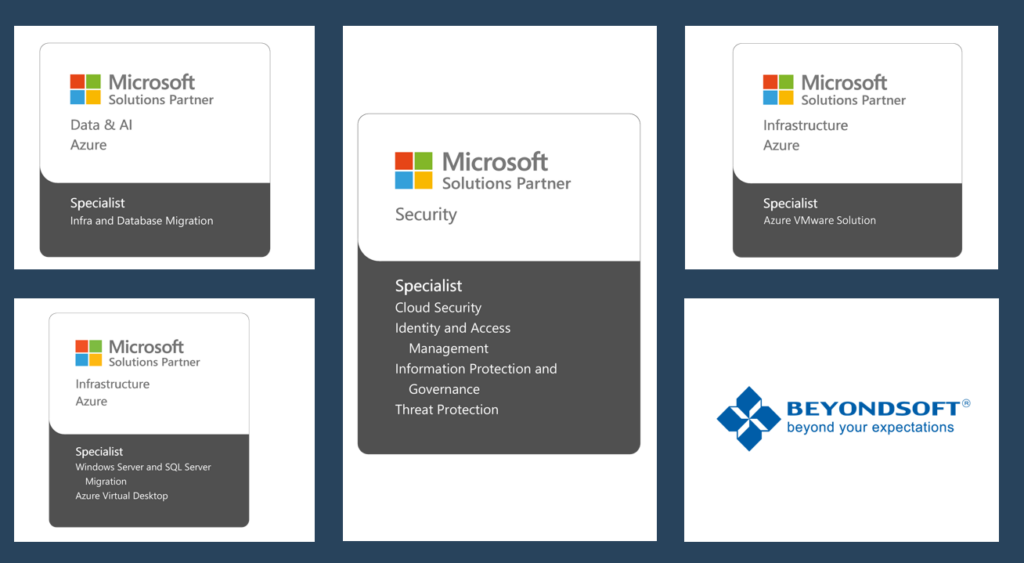
We have earned the following Microsoft Azure specializations: (1) Infra and Database migration to Microsoft Azure, (2) Microsoft Azure Virtual Desktop, and (3) Microsoft Azure VMware Solution, where our company is one of the few companies worldwide to hold this specialization.

As for the Security specializations offered by Microsoft, we hold all four: (1) Cloud Security, (2) ID & Access Management, (3) Information Protection & Governance, and (4) Threat Protection.

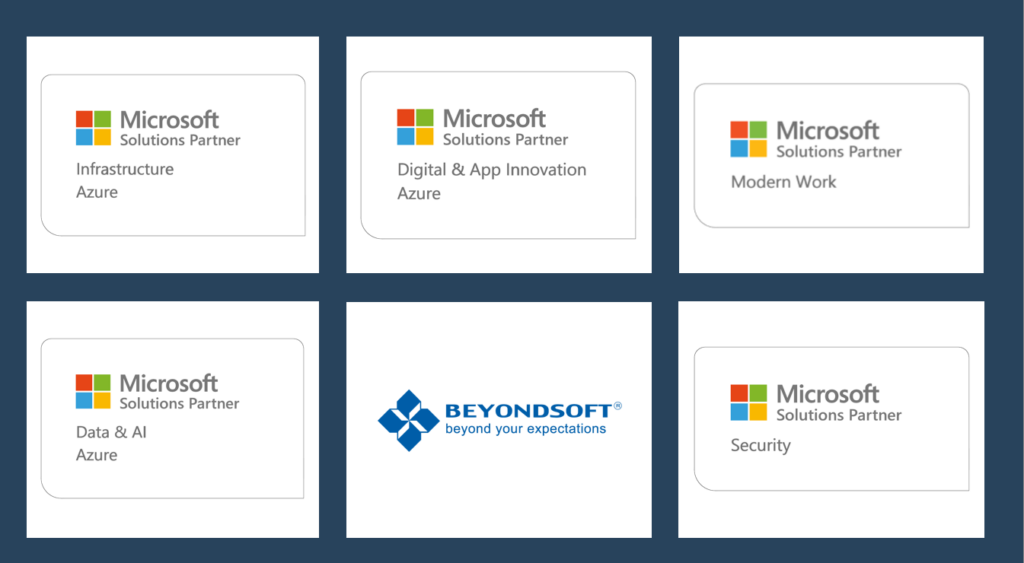
In addition, we have the Microsoft Solutions Partner designation in 5 of the 6 areas offered by Microsoft: (1) Infrastructure (Azure), (2) Digital & App Innovation (Azure)​, (3) Modern Work, (4) Data and AI and (5) Security.

The process of obtaining a Microsoft specialization is demanding and arduous. After meeting the prerequisites, we must comply with a third-party audit, requiring substantial time and resources for preparation. The specializations must be renewed annually, requiring annual audits. We maintain these specializations to demonstrate our commitment to keeping on top of our game in these areas of focus.

Of special note, we were recently awarded the Azure Expert Managed Services Provider (MSP) badge, only given to the most high-fidelity cloud managed service providers. This designation requires an even more intensive training and audit process. The payoff is that you have the confidence of working with the most capable partner possible for all Azure-related issues.

How we drive customer success with Microsoft specializations

We are a catalyst for our customers with respect to their cloud migrations, system upgrades, and other major IT events. Our Microsoft specializations serve as a demonstration of our ability to do so. In addition, our specializations result in Beyondsoft working on more IT projects, thus giving us more experience delivering results – yet another benefit for our customers.

“It is rewarding to be able to rely on a technical team like Beyondsoft, which offers the highest quality, knowledge, agility, and a focus on customer satisfaction.”

Eduardo Ângelo, WeVets, Director of IT and Customer Experience

As the business landscape changes, Beyondsoft has future plans for additional Microsoft specializations. Specifically, the Beyondsoft team is seeking to obtain three more specializations soon: (1) Analytics on Microsoft Azure, (2) AI and Machine Learning in Microsoft Azure, and (3) Low Code Application Development, to better assist customers with the Microsoft Power platform.

Tap into our expertise to maximize your company’s Microsoft capabilities

Make the most out of Microsoft cloud and IT technology by tapping into our expertise. With Microsoft specializations, we helped numerous organizations accelerate their business success. Contact us today to see how we can do the same for you.
Transforming Knowledge Management using Generative AI

The modern business landscape is evolving at an unprecedented pace. To stay competitive, organizations must find ways to efficiently manage and utilize knowledge across departments and roles. Fortunately, advancements in artificial intelligence (AI) present new opportunities to enhance knowledge management in transformative ways.

In essence, knowledge management is about capturing, distributing, and effectively using knowledge in an organized fashion. Modern knowledge management is interactive and dynamic. The integration of AI and chatbots enables you to engage with the system in real-time to view the information you need.  

However, even with AI and chatbots at the helm, modern knowledge management systems grapple with their own set of challenges:

Search Accuracy:

  • Despite using AI, most systems rely on question-answer mapping, resulting in an exhaustive list of potential questions that can be difficult to compile. This can cause chatbots to struggle with unfamiliar or unexpected queries.

Maintenance Challenges:

  • Formatting Complexity: Training AI models often require specific document formats, making maintenance intricate, especially for non-technical users.
  • Retraining Efforts: Even a small word change can be time-consuming and increases cost model retraining.
  • Multilingual Hurdles: Multilanguage support requires creating separate documents and training individual models, increasing time and cost investments.

Contextual Constraints:

  • Many AI-based systems lack the ability to grasp context, hindering their understanding of the true intent behind a question.

As we tackle these issues, the potential of generative AI shines brightly, hinting at a future where knowledge management is both efficient and intuitive, considering context as well.

Beyondsoft’s journey in AI: Pioneering the future with tangible innovations

Embarking on our AI voyage more than five years ago, we set forth with a singular vision: to revolutionize the way organizations harnessed knowledge through the power of AI. Our initial efforts were rooted in AI-driven tools like chatbots to redefine knowledge management. These tools, while groundbreaking, marked just the beginning of our ambitious journey. We focused on no-code maintenance tools, as we know the complexities of AI and we want you to use AI tools to complete your daily tasks rather than updating codes.

Through continuous learning, we created an auto machine learning (ML) framework to streamline the model maintenance process. We made AI maintenance more intuitive and time-efficient so that individuals without a technical background are not intimidated to use advanced AI.

AI for your business: The synergy of chatbots, auto ML framework, and generative AI

As we forge ahead, our journey in AI is guided by our commitment to innovation and inclusivity.  We continue to break new ground, ensuring that our AI solutions are user-friendly and cost-effective.

Building on our success with chatbots we expanded our AI toolset to a multifaceted AI platform. Our new AI platform houses a suite of solutions tailored to various industry needs. Within this expansive portfolio, the knowledge solution, rooted in generative AI, stands out. It’s designed to revolutionize how you manage both structured and unstructured knowledge easily. It’s more than just storage and retrieval, this solution harnesses the power of generative AI to understand, manage, and even generate knowledge, ensuring you consistently receive accurate and contextually relevant information. We also integrated BIOPs™, a familiar AI foundational engine to many of our customers, that houses the auto ML framework and facilitates the creation of a diverse range of AI services to the multifaceted AI platform.

With the new integration, the result is a harmonized solution, redefining the way businesses approach knowledge management. No matter your level of technical know-how, our comprehensive AI integrated solution gives you an edge on:

  • Natural Conversations: Our aim is to make interactions feel like genuine human conversations. For instance, if you ask about the benefits of program A, you’ll get a detailed summary that’s as if you were talking to an expert.
  • Contextual Understanding: Our solution goes beyond just spotting keywords. If you ask about the best product for your needs, it understands what you’re really looking for and gives you a personalized recommendation, not just a generic list.
  • Easy Customization and Updates: You can easily update or change things without needing technical skills. For example, if you want to update a product’s benefits, anyone on your team can do it effortlessly.
  • Fit for All: Whether you’re a small startup or a big company, our platform grows with you. It’s designed to meet your knowledge management needs, no matter your size.
  • Safe and Accurate Data: Your data security is crucial. We’ve got strong encryption and checks to make sure your information is safe. Plus, our AI gives you the right info with precision.
  • Real-time Insights: You’ll get valuable info on how users interact, common queries, and system performance. This helps your business improve and provides better knowledge based on what users want.
  • Multilingual Support: In today’s global business world, language shouldn’t be a barrier. Our solution works seamlessly in multiple languages, so you can serve diverse clients.
  • Strong Foundation: While we’re talking about our knowledge management solution here, it’s built on the solid BIOPs™ framework. That means you’re not just getting cutting-edge tech, but also a reliable and adaptable system.

By bringing these abilities together, our solution stands out in the AI-driven knowledge management field. It demonstrates our commitment to offer a platform that goes beyond the basic, making sure every question gets the right, helpful, and in-depth response.

“It’s clear that this combined AI solution is more than just a tool—it’s a paradigm shift in how businesses approach knowledge management. With configurable knowledge bases and personalized optimization, you’ll have full control over the system, allowing you to tailor it to best suit your specific requirements. In the intricate dance of technology and user needs, our solution gracefully leads, setting the stage for a future where knowledge is accessible, relevant, and empowering,”

says Marshall Ma, CEO of Beyondsoft Consulting Inc.

Next step

Looking to offer responses that understand context, enhance customer support, and boost efficiency and innovation? We can help you achieve your vision.

Accelerate cloud migration and modernization

These days, every company is a technology company. Those who thrive employ modern technology to elevate productivity, efficiency, and sustainability and differentiate themselves from competitors. But over the years, custom application portfolios have grown increasingly complex, even before considering increased attrition and rapid change in programming languages, frameworks, and open-source software. This complexity can hinder the speed and success of cloud migration and overall modernization efforts. Discover how industry digital leaders use software intelligence to gain visibility into their portfolios, overcome complexities, and accelerate cloud migration and modernization.

The cloud migration analysis paralysis epidemic

Digital transformation has become a boardroom topic. Board members know that to survive, they need to migrate to the cloud and modernize legacy, monolithic applications to be able to respond to changing business needs faster and with greater agility. And while such projects appear simple enough on paper, they’re incredibly complex under the hood. Project complexity quickly escalates from obsolete, undocumented code to mounds of technical debt to complicated networks of dependencies. As these unexpected blockers pile up, it can be hard to know where to start, leading to analysis paralysis.

Software intelligence helps with rapid facts-based analysis of custom applications portfolios to support informed, vendor-agnostic cloud migration strategies. It enables the prioritization and segmentation of applications into categories such as rehost, refactor, rearchitect, rebuild, or retire. Furthermore, it helps organizations avoid U-turns in the migration journey by understanding code patterns that could potentially block migration.

The new frontier: app modernization

Despite significant public cloud growth, only a fraction of enterprise workloads have migrated to the cloud. Incredible value remains to be unlocked from modernizing custom, business-critical legacy applications. Challenges include a lack of documentation, a wide array of programming languages and frameworks, scarcity of skilled people who understand legacy technologies, and sheer complexity.

Of course, just as a surgeon would not undertake a complex procedure without an MRI, businesses should not embark on an app modernization journey without visibility into their legacy applications. Software intelligence provides visibility into the cloud migration and modernization journey, improving time to value and reducing overall risks. Software Intelligence analyzes the inner workings of your application portfolio, including data and source-code components and dependencies, to generate interactive architecture maps and insights into cloud readiness and software integrity.

Beyondsoft partners with CAST, a leader in software intelligence, to provide a fact-based analysis of custom source code in your application portfolio. The analysis helps rationalize your portfolio for cloud migration, identifies blockers, surfaces opportunities for containerization and PaaS, and even identifies open-source IP risks. This information is used to define the overall migration strategy and effort, saving organizations time, money, and frustration. CAST Imaging technology reverse-engineers dependencies and automatically generates interactive maps of the software’s architecture and structural integrity to accelerate and de-risk the modernization journey.

Transportation leader accelerates cloud migration and modernization

A global transportation leader with hundreds of custom applications wanted to expedite their migration to the cloud and modernize core systems. Their goal was to reduce costs, increase resilience, improve the client experience, and deliver new products and services faster.

In just two weeks, CAST software intelligence gained visibility into the client’s entire application portfolio, including health, blockers for cloud PaaS, and open-source components for each application. In addition, modernization plans were created for the near- and mid-term, identifying quick wins and opportunities to decommission or replace obsolete frameworks.

Fast-track your digital transformation with software intelligence

Cloud migration and application modernization is a complex undertaking requiring a detailed and fact-based understanding of your complete environment. By leveraging CAST software intelligence with Beyondsoft’s expertise in migration and optimization, you gain a much better understanding of complexities, dependencies, and priorities, so you can build a more holistic strategy.

Contact Beyondsoft to initiate an assessment of your custom application portfolio.

From cloud migration to automation: Insights to inform your 2022 IT planning

As we bid farewell to 2021 and peek around the corner at 2022, many of us are putting plans in place to increase efficiencies, boost product and service quality, or expand into new markets. To help inform your IT planning, we’ve put together a quick collection of articles. To find out how Beyondsoft can help your organization accelerate transformation in 2022, give us a call.

Increase performance, scalability, and cost-efficiency with a cloud migration

Migrating to the cloud offers benefits ranging from decreased licensing and storage costs to improved performance and scalability. A move to the cloud also positions organizations to advance their data analytics and even drive new revenue streams. But, of course, ensuring a successful data migration requires detailed planning and preparation as well as the right data migration strategy.

If you’re looking to migrate to the cloud, check out these helpful insights.

Migrating to the cloud? You need a cloud assessment

Migrating to the cloud is easier said than done, particularly for larger organizations. A cloud assessment can help ensure your strategy aligns with business objectives, understand and mitigate risks, and build a realistic roadmap.

Choosing the right data migration strategy

This article explores four common data migration strategies, including their advantages and how a data migration assessment can help you make the right choice.

Demystifying data migrations: Understanding the lift and shift

The right data migration strategy can save you time and money while increasing performance. This article explores the pros and cons of the lift-and-shift data migration strategy.

How a upsertable data lakes can simplify the data lake journey

Thinking about migrating to a data lake? Upsertable data lakes like Delta Lake and Hudi can ease your transition from traditional SQL databases to a data lake architecture. In this article, learn about the pros and cons and how upsertable data lakes reduce complexity.

Drive greater quality and productivity through automation

By taking advantage of technologies like artificial intelligence (AI) and machine learning (ML), organizations across every industry are reaping the rewards of automation, including improved efficiency, productivity, and profitability and reduced exposure to human-caused mistakes. If you’re planning to embrace the advantages of automation in 2022, be sure to read these blog posts.

Do yourself a favor: audit before you automate

When it comes to automation, complexity lurks under the hood. In this article, we explore why you should always audit before you automate.

Say hello to productivity with intelligent automation

See how intelligent automation technologies like AI can help your business eliminate manual processes to drive productivity, quality, and profitability.

Considerations for designing a test automation strategy

A good test automation strategy can save time and money and boost quality. Keep these considerations in mind when planning your strategy.

Harness the power of data analytics

AI and ML are also helping organizations access a treasure trove of data and glean actionable insights that position them to compete at a higher level.

How machine learning unlocks data to target customers & drive sales

In this article, discover how machine learning can help your e-commerce business convert data you already have into actionable insights and predictions to expand sales.

Position your organization to accelerate success

The global market constantly fluctuates and evolves—and organizations must also evolve. But aligning your teams—including globally distributed service center partners—to support business needs and drive growth takes the right expertise combined with the right technologies. Use these articles to position your teams for increased success.

Take a continuous improvement approach to organizational design

Keep your teams functioning at their best by taking a continuous improvement approach to organizational design. This article explores some benefits and best practices that have helped us grow successful, global teams.

Streamline operations across globally distributed contact centers

In this article, find out how machine learning streamlines the management of globally distributed contact centers.

Insights to help organizations manage globally distributed customer support partners

Ensuring a consistent customer experience and seamless operations across globally distributed customer support partners can be challenging. Get insights to help you streamline how you manage multiple partners.

Scale quickly and drive efficiency through outsourcing

Whether you need specialized talent or an entire service desk team, outsourcing can provide you with the answers you need to scale your organization and increase capacity while keeping your staff focused on your core business. Find out how outsourcing can help you achieve business goals without hiring additional people.

What’s the right fit: Professional services, managed services, or staff augmentation?

Discover how professional services, managed services, and staff augmentation compare—and which is the right service model for your business.

Tap skilled IT engineers without adding headcount

To stay competitive, organizations must embrace innovation. Find out how to access highly skilled IT engineers without increasing headcount.

Four signs that you need a managed services provider

Wondering if a managed services model is the right fit? Here are four signs that you need a managed services provider.

6 reasons why you should outsource your service desk

If you’re looking to expand, find out why you should consider outsourcing your service desk and what to look for when choosing a service provider.

Rely on a trusted, global technology partner

As a global IT partner, Beyondsoft thrives on innovating scalable solutions that solve customer challenges and accelerate business. In fact, both medium-sized enterprises and Fortune 100 companies rely on Beyondsoft to help them transform business–whether they’re migrating to the cloud, streamlining through DevOps, automating through AI and machine learning, or putting powerful predictive analytics to work.

To learn more about how we can help you accelerate business in 2022, be sure to contact us.

Demystifying data migrations: Understanding the lift and shift

Data migrations can be incredibly complex, but also beneficial from a business standpoint. I recently wrote an article, Choosing the right data migration strategy, that introduces the four most common types of data migrations, including the lift and shift, the data lake, a combination of lift and shift and data lake, and finally, hybrid streaming.

Many factors play into choosing a data migration strategy including data architecture, applications, business needs, and other drivers. Today, I want to dive into the most basic of these strategies: the lift and shift data migration.

Understanding the lift and shift data migration

To recap, the lift-and-shift involves moving applications, data, and other operational solutions used on-premises and simply transferring them to the cloud, without redesigning or changing the workload. The final result ideally looks and behaves similar to the on-premises database workload.

In fact, the lift and shift approach is the original data migration strategy, dating back to when fewer cloud solutions were available. Now, of course, organizations can choose from many cloud-based, serverless solutions to optimize cost while simultaneously improving performance. Platform advancements and new products continue to simplify and accelerate data migration projects.

The lift and shift has several advantages

The lift and shift is the fastest way to move an on-premises database onto public cloud resources because you don’t need to spend time on optimization or code revisions. It’s also the cheapest migration model since you aren’t paying for code or configuration changes. However, these upfront savings can also cost more in the long run if you miss opportunities to optimize workload costs. 

From a planning standpoint, it requires the least amount of project resources. In select situations, this strategy can be less risky than refactoring an app. This is especially true if you don’t have the resources to perform code updates without compromising performance.

Finally, sometimes, optimization is just too costly with existing resources. Lift and shift can allow companies to prolong the lifespan of a struggling workload.

The lift and shift also has a few disadvantages

As with most things, the lift and shift also has some drawbacks that must be considered. For example, organizations that forego the opportunity to first optimize code and configurations or refactor workloads for the cloud can miss out on long-term cost savings and some of the benefits a cloud infrastructure has to offer, such as improved performance, automation, and stability. Additionally, the technical debt incurred on-premises will migrate to the cloud.

The cloud can provide a single way to manage and scale the full scope of your infrastructure using repeatable processes, especially if you use migration as an opportunity to understand existing applications and data. However, lifting and shifting an on-premises database without a full assessment can worsen visibility issues and cause cloud troubleshooting challenges.

From a process standpoint, confusing a lift-and-shift data migration model with a copy-and-paste strategy is a disaster recipe for companies that put no effort towards planning or migration testing before trying to go live. Finally, the cloud can simplify or complicate optimization problems. Sometimes, it’s much harder to optimize a legacy workload without native environment resources.

The variations of the lift and shift approach

While the lift and shift is the most basic strategy, organizations can opt for multiple variations depending upon their needs and challenges. Choosing the right strategy involves an understanding of the environment, workloads, timelines, and leadership goals, among many other factors. Here are a few:

  1. Pure lift and shift: Migrating a workload with no refactoring or rebuilding—also referred to as “rehosting.”
  2. Lift, shift, & optimize: A migration that involves minimal efforts to optimize a workload, generally post-migration.
  3. Refactoring: Significant changes to configurations or code during a cloud migration to enhance performance or behavior.
  4. Containerization: Bundling individual app components, such as libraries and dependencies, into containers separate from the infrastructure to promote flexible migrations between premises and cloud environments.
  5. Rebuild: Completely redesigning a cloud-native application in cases where, for example, a license has expired or an application is no longer supported.

Is it the right strategy for your data migration?

It depends. Migration teams with the support of business leaders must ultimately decide if the lift and shift is the right strategy. It’s critical to conduct a full cloud assessment to understand:

  • Timeline, business goals, and challenges
  • Strategies for migrating workloads
  • Pre-migration or post-migration optimization work
  • Cloud adoption readiness across your business
  • Risks of optimizing and refactoring
  • Costs and licensing
  • Expected performance
  • Poor bandwidth may pose migration challenges and lead to performance issues later on
  • Post-migration data transfer costs

Sometimes, lift and shift is the only option, as in the case of one of our automotive manufacturing customers, whose existing data center was closing. For them, moving their portfolio of business-critical applications to another facility was not cost-effective. Instead, we proposed a lift and shift to Amazon Web Services (AWS), enabling them to forgo expensive hardware and licensing costs while enjoying the benefits of the cloud. The move to the cloud also positioned our customer to refactor their vehicle configuration service to leverage the full capabilities of AWS.

A cloud assessment from us can help you determine the best migration strategy for your needs and challenges. Our certified practitioners have performed hundreds of data and application migrations for enterprise customers and can help you create a roadmap to achieve your data migration goals. To learn more, contact us today.

How a upsertable data lakes can simplify the data lake journey

Migrating data from traditional SQL databases to a data lake presents multiple advantages for organizations.

Data lakes offer the flexibility and scalability to manage growing volumes of data. Data lakes enable organizations to take advantage of disconnected, structured and unstructured data streams such as customer data, IoT sensors, and click streams. Organizations can more cost-effectively store unused data and leverage it down the road for advanced analytics as opportunities arise and as new technologies become available. Furthermore, because they separate storage from compute, data lakes offer far greater flexibility and scalability.

At the same time, migrating to a data lake architecture can be daunting for organizations whose database administrators (DBAs) are accustomed to SQL databases and transactions characterized by atomicity, consistency, isolation, and durability (ACID). Because data lakes are not ACID-compliant, simple DBA tasks such as updating or deleting records are not as straightforward, since data lake files cannot be changed or updated directly. Instead, these tasks require complex scripting and file handling.

The good news is that traditional DBAs can perform these operations with a similar level of skill and effort using what we’re calling “upsertable data lakes”—essentially ACID-compliant, modern table formats that combine the best features of data lakes and data warehouses. In this article, we’ll explore how upsertable data lakes such as Delta Lake and Hudi can ease your organization’s transition to a data lake architecture, all while leveraging the experience and knowledge of your existing DBAs.

Some challenges of data lakes

Managing a data lake is different from managing a relational database and requires different skillsets. Data lakes require data validations in multiple places, and preventing failures necessitates the handling of files and complex scripting that is unfamiliar to traditional, SQL-centric DBAs.

Then there are the challenges of cleansing or deleting data to comply with data retention and privacy laws such as GDPR. In a relational database, these tasks can be accomplished easily through SQL commands. But in a data lake, it can be a complex endeavor, requiring skillsets that fall outside a traditional DBA’s wheelhouse. And because files are immutable, there is some risk of instability during transitions if transactions are not ACID compliant.

How upsertable data lakes reduce complexity

Because they fuse the best of data lakes and data warehouses, upsertable data lakes such as Delta Lake and Hudi provide a more familiar interface for DBAs. Upsertable data lakes take what DBAs love about data warehouses and apply them to a data lake setting, which can make the transition to a data lake architecture easier. Thanks to a rapidly closing feature gap between upsertable data lakes and relational databases, the data lake transition is a much more familiar journey.

To illustrate this feature familiarity, let’s say a DBA needs to delete or update a record. Performing this simple task in a traditional data lake can require the creation of complex scripts. But with an upsertable data lake, it’s a simple matter of running a delete statement or an update statement, as would happen in a relational database.

Furthermore, due to the immutable nature of data lakes files, changing the record requires the creation of a new file with the change, and the deletion of the old one. During this process, oftentimes the data will be in an unstable state. This is where an upsertable data lake comes in like a hero, bringing ACID compliance to transactions to guarantee data validity. Thanks to ACID compliance, an upsertable data lake abstracts all the file handling underneath the hood, which means DBAs no longer have to think about the file handling. The data is never in an unstable state.

Contact Beyondsoft for a data architecture health check

Where are you on your data lake journey? Beyondsoft has performed hundreds of data migrations and big data projects for large enterprise customers. Our certified practitioners have hands-on, best-practice knowledge of all the major platforms, including AWS and Azure.

We can partner with you to analyze your data architecture and business requirements to help you determine if an upsertable data lake is the right fit and determine the best migration strategy. To learn more about how Beyondsoft can help you with your data lake journey, contact us today.

Choosing the right data migration strategy

Migrating to the cloud offers multiple benefits. Organizations looking to modernize can reap enormous advantages that range from decreased licensing and storage costs to increased performance and scalability. Migrating to the cloud enables organizations to advance their data analytics and even drive new revenue streams.

Of course, detailed planning and preparation are a must if you want to increase the success of your data migration. And choosing the right data migration strategy is a key part of this process.

I’ve participated in countless data migrations. Below, I’ll overview the four approaches that I most often see, as well as their advantages and disadvantages. For additional help choosing the right strategy, be sure to check into a data migration assessment.

1. Lift and shift approach

The “lift and shift” is the most basic data migration strategy. Organizations use this approach when taking the same database technology that they’re using on premise—say, an Oracle database—and shifting it to the cloud.

The main advantage of this approach is its simplicity and speed and the availability of tools that can facilitate the migration. But keep in mind that when you lift and shift an existing database, you’re also moving all of its hidden problems, hacks, and band-aids to the cloud. The technical debt you had on premise will still be an issue in the cloud—sort of like moving out of a roach-infested house and taking the roaches with you to your new home.

2. Data lake approach

The data lake approach involves removing data from an on-premise database and storing it in a solution such as Amazon S3. For this approach, you can employ a variety of available technologies to access, analyze, and query the data. This approach also gives you the ability to load the data into your database of choice, such as Redshift. Plus, because there’s a middle ground where the data sits, you can load it into the target database in parallel.

This approach offers the flexibility to use any database. While it does require redesigning your database to some degree, you can make changes to the data along the way and increase the performance in your target database. Additionally, because you are building something new and modernizing your database application, you can exterminate those roaches.

Additionally, this approach enables you to separate storage from compute, so you can take advantage of newer compute technologies as they emerge. There are also cost advantages of separating data that is accessed seasonally from data that is accessed regularly. A data lake allows you use compute power to handle those spikes and shut if off when the data isn’t being used.

Of course, there are some tradeoffs. Direct queries against a data lake are typically slower than queries against a database. In situations where you have a higher performance requirement, it makes sense to load that data into a higher performing database. But you can still load your data from the data lake into a tool that allows that high performance. Another tradeoff is that data lakes introduce a new set of technologies to engineers and DBAs who must contend with a steep learning curve. This new domain of knowledge requires considerable ramp up.

3. Combo approach: Lift and shift + data lake

Sometimes, there is a pressing business need to migrate—such as a datacenter that is shutting down. The timeline is short, and the organization needs to get the database off premise quickly—before migrating to a new database solution.

In this hybrid approach, you can combine the above-mentioned strategies, first using the lift and shift approach to migrate the existing database to the cloud, then, taking the time to migrate to a new database such as Redshift or Aurora.

In addition to getting to the cloud quickly, this approach gives you breathing room to determine the best database to be used for your data. The disadvantage is that in some cases, it ends up creating more work in the long run, since you have to make your database work in the cloud. And then you have to migrate to a new database technology.

4. Hybrid streaming approach 

In some cases, an organization wants the benefits of a data lake in the cloud, but for business reasons must keep an existing transactional database on premise. Using change data capture (CDC), you can enable changes on premise to stream into the cloud in near real-time. By taking a streaming approach to getting data into the cloud, you can get benefits from the cloud without moving the database. On the downside, replication from the on-premise database is more prone to failure since typically the same redundancies aren’t in place.

Choose the right strategy with a data migration assessment

Choosing the right data migration strategy is critical to your overall success, and depends upon business requirements and drivers, pain points, performance needs, short-term plans, future goals, and multiple other factors.

A data migration assessment from Beyondsoft applies a holistic approach to preparing for a data migration and provides a sound foundation and blueprint for completing your database and application migration. Our proven execution model addresses areas such as business applications and workloads, technical operations, production support, and training to determine the best migration architecture and strategy. Our experts work with you to perform a detailed analysis of your existing database and application architecture and create a roadmap for your migration that includes business, functional, technical, and testing requirements as well as recommendations for addressing gaps. We also create an ROI model that demonstrates performance measures and the time it will take to recoup the cost of your migration.

Here at Beyondsoft, we’ve performed countless database migrations and big data projects for large enterprise customers around the globe leveraging technologies such as PostgreSQL, Amazon RDS, Amazon Redshift, Vertica, Presto, ConvergDB, and more. A data migration assessment is a worthwhile investment that will save you time and money down the road. To learn more, talk to one of our data migration experts.

How to increase the success of your data migration

Data migrations are a popular undertaking these days. In fact, according to the IDC, data migrations comprise around 60% of all large enterprise IT projects. Although the reasons can vary, data migrations are typically motivated by cost reduction, performance, or a combination of the two.

From a cost perspective, large databases and data warehouses can get expensive and licensing fees can escalate out of control. Meanwhile, migrating to less expensive cloud-based solutions can save substantial money.

From a performance standpoint, legacy platforms that are approaching end of life can be a forcing factor. Decoupling data from compute and leveraging cloud capabilities can increase agility and performance. Finally, some enterprise organizations are looking to monetize data and expand market share by taking advantage of more modern platforms.

Ultimately, enterprises that want to compete effectively and drive business growth must embrace modern, more agile solutions. Yet, for all its benefits, a data migration can be a complex and time-consuming undertaking, fraught with the unexpected. Plus, for the uninitiated, it can be hard to know where to start.

The good news is that the proper planning and preparation, as well as choosing the right migration tools, can reduce risk, streamline your data migration, and optimize performance and return on investment (ROI). In this article, I want to explore a few common data migration obstacles and pitfalls and outline steps you can take to minimize risk and increase the success and speed of your data migration.

Common obstacles 

One key obstacle to moving forward with a data migration is lack of internal expertise. Most organizations simply don’t have the skillsets to perform a migration in-house. Hiring dedicated internal experts can be cost-prohibitive. Furthermore, even if an organization has the in-house talent, they’re likely consumed with day-to-day, business critical tasks and don’t have the time to devote to a migration.

Many organizations don’t have methods to obtain a clear data migration path and ROI, which means they’re mostly focused on the price tag instead of increased performance and future cost savings. Additionally, many organizations haven’t pinpointed the desired outcomes and performance expectations of their data migration, which can set them up for headaches down the road.

Finally, many organizations simply haven’t had exposure to multiple platforms, making it difficult to choose the best solution. We’ve seen enterprise customers default to the platform that they’re most familiar with only to be disappointed with the results and forced to consider a second migration to a more suitable platform.  In this case it is better to understand future business requirements before solutioning.

Common pitfalls 

Without the proper planning and expertise, many things can go wrong. From a business standpoint, there is tremendous pressure on the product owner who can face financial and reputational risks caused by data losses, frequent or extended downtimes, and security issues. To minimize these kinds of issues, it’s critical to establish clear expectations and success criteria around delivery timeframes, expected downtimes, data validation, cost optimization, and long-term post-migration support.

From an ROI standpoint, many organizations fail to prioritize properly, leading to disappointing time to value. It’s important to remember that database migrations also have applications attached, and when there are a large number, the entire effort can be very time consuming, not to mention costly. Choosing the most profitable application sets as top-priority migration candidates can deliver short-run profit objectives and long-term benefits with cloud innovations.

Additionally, even with thorough planning, there will always be unknowns. When I talk about performing a data migration, I often use the metaphor of remodeling a house. While much of the remodeling work is obvious, it’s what’s behind the walls or under the floor joists that can be most challenging. Whether it’s faulty wiring, mold, or structural issues, once you begin tearing down walls, you’re sure to come across some unknowns that cost time and money to correct.

The same is true for a data migration. For example, ETL and the way in which data has been blended from multiple sources can be difficult to contend with. You may find stored procedures and business logic that is tied into the database that you weren’t expecting. Depending upon the age of the database, you may have had multiple DBAs doing the work, and you may find yourself unraveling what they’ve done, without any historical knowledge to understand the full impacts.

Finally, when migrating from one database or data warehouse to another, it’s critical to understand the business logic and stored procedures that exist between the two. There are tools-based solutions available that can identify these migration patterns for you and automate a substantial portion of the migration process. These tools can help speed up the migration, increase accuracy, and minimize risk of human error. However, without in-depth experience and knowledge of data migrations, it can be hard to know which tools to use and how to use them. And not having the right tool can add several months to a migration.

Why you need a data migration assessment

These obstacles and pitfalls can impact not only your budget and timeline, they can also impact the overall outcome. Which is why the first thing that any enterprise organization should do is to engage with an industry expert like Beyondsoft to perform a thorough data migration assessment.

A data migration assessment from Beyondsoft provides a solid foundation for completing your data, ETL workflow, reports, and applications migration. Our proven execution model addresses areas such as business applications and workloads, technical operations, production support, and training to determine the best migration architecture and approach—including the selection of tools to accelerate your migration.

Our experts work with you to understand your business needs and objectives and develop a clear business case for initiating a migration as well as expected outcomes. We work with you to define specific success criteria to enable on-time delivery, minimize customer disruptions, ensure data accuracy, optimize costs, and smooth the post-migration transition through support and training.

As part of our assessment, we perform a detailed analysis of your existing database and application architecture, including schema, objects, code, and data volume and create a clear roadmap for your migration that includes business, functional, technical, and testing requirements as well as recommendations for addressing identified gaps. Because we have experience with multiple migration patterns, we can quickly identify stored procedures and business logic and pinpoint the right tools-based solution to accelerate your migration.

We also work with you to prioritize migration candidates using a proven, best practice approach. We examine factors including application size, complexity, cost, savings, and overall effort to determine the candidates that deliver an ROI model that maximizes migration time to value while also setting you up for long term success.

As a trusted enterprise business partner, Beyondsoft has successfully delivered on countless database migrations and big data projects. Our experienced, global experts are deeply familiar with technologies such as PostgreSQL, Amazon RDS, Amazon Redshift, Vertica, Presto, ConvergDB, and more.

A data migration assessment is a worthwhile investment that will save you time, money, and frustration down the road. To learn more, talk to one of our experts.