How Beyondsoft unlocks IT innovation and business success with Microsoft specializations

Microsoft is one of the premier IT cloud providers, offering an array of technology to meet business needs. But even with Microsoft solutions in place, there is the uncertainty of not understanding all the capabilities and underutilizing the tools. In addition, familiar IT pain points still present themselves with Microsoft implementations, such as software compatibility, maintenance, storage, network, and data security.

Working with us, an IT consultancy with extensive experience in Microsoft solutions can help immensely. We have earned many Microsoft specializations demonstrating our in-depth expertise and commitment to be your first-rate partner for digital transformation.

Here we discuss what Microsoft specializations mean, why they are important, and how we can help you leverage Microsoft tools to the greatest extent possible.

Why is Microsoft specialization important to you?

It is as true for Microsoft as it is for any IT technology – most companies utilize only a small percentage of the full capabilities of Microsoft solutions. A specialized Microsoft solution partner can help your organization increase that percentage, ensuring you are making full use of the product features and realize cost savings fast.

Microsoft awards specializations to solution partners who have demonstrated technical expertise with Microsoft tools within specific contexts. Just as a professional driver can bring out more of the capabilities of a race car than an amateur, an IT consultant with Microsoft specializations can help you gain more benefits from the Microsoft technology you already have in place.

Beyond better use of existing solutions, your organization also may be able to unlock more opportunities by implementing additional Microsoft tools. Microsoft has a full suite of technologies, ranging from desktop applications to cloud solutions such as Azure, and all of them are fully integrated and secure. A company can gain a large competitive edge by moving more workflows and processes to Microsoft solutions, and a Microsoft solution partner, like us, can help you do so.

Our suite of Microsoft specializations

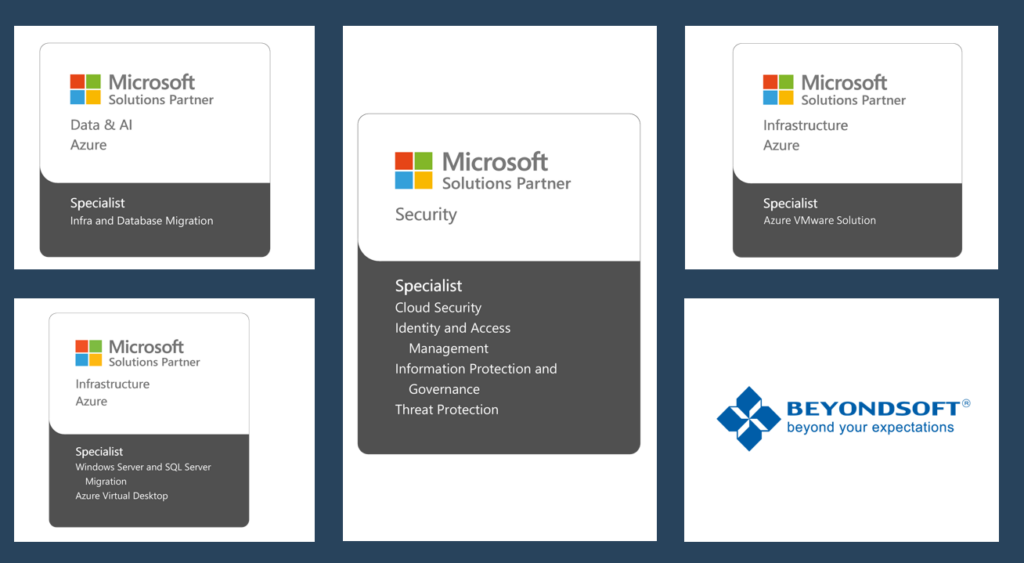
We have earned the following Microsoft Azure specializations: (1) Infra and Database migration to Microsoft Azure, (2) Microsoft Azure Virtual Desktop, and (3) Microsoft Azure VMware Solution, where our company is one of the few companies worldwide to hold this specialization.

As for the Security specializations offered by Microsoft, we hold all four: (1) Cloud Security, (2) ID & Access Management, (3) Information Protection & Governance, and (4) Threat Protection.
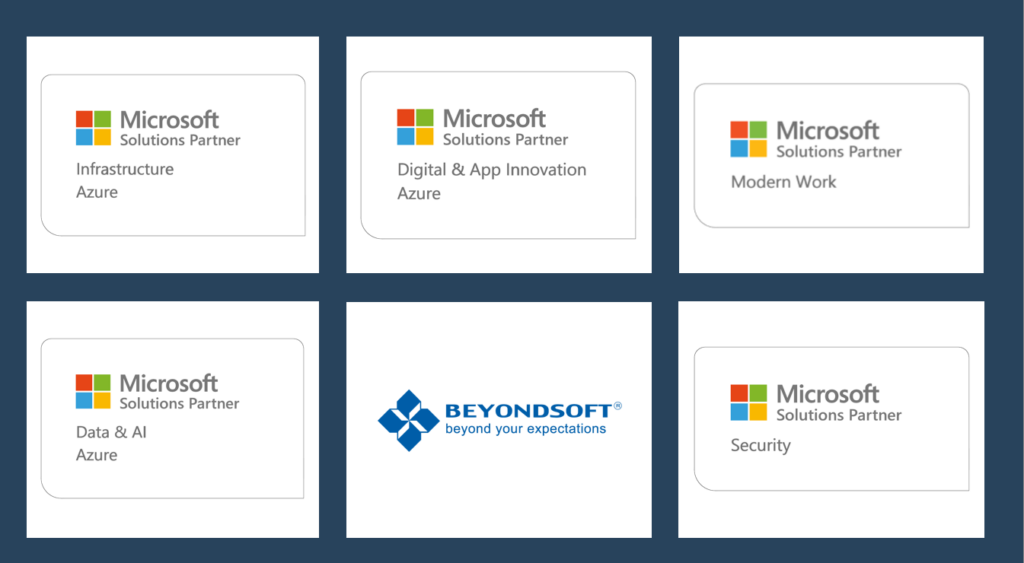
In addition, we have the Microsoft Solutions Partner designation in 5 of the 6 areas offered by Microsoft: (1) Infrastructure (Azure), (2) Digital & App Innovation (Azure)​, (3) Modern Work, (4) Data and AI and (5) Security.
The process of obtaining a Microsoft specialization is demanding and arduous. After meeting the prerequisites, we must comply with a third-party audit, requiring substantial time and resources for preparation. The specializations must be renewed annually, requiring annual audits. We maintain these specializations to demonstrate our commitment to keeping on top of our game in these areas of focus.

Of special note, we were recently awarded the Azure Expert Managed Services Provider (MSP) badge, only given to the most high-fidelity cloud managed service providers. This designation requires an even more intensive training and audit process. The payoff is that you have the confidence of working with the most capable partner possible for all Azure-related issues.
How we drive customer success with Microsoft specializations

We are a catalyst for our customers with respect to their cloud migrations, system upgrades, and other major IT events. Our Microsoft specializations serve as a demonstration of our ability to do so. In addition, our specializations result in Beyondsoft working on more IT projects, thus giving us more experience delivering results – yet another benefit for our customers.

“It is rewarding to be able to rely on a technical team like Beyondsoft, which offers the highest quality, knowledge, agility, and a focus on customer satisfaction.”

Eduardo Ângelo, WeVets, Director of IT and Customer Experience

As the business landscape changes, Beyondsoft has future plans for additional Microsoft specializations. Specifically, the Beyondsoft team is seeking to obtain three more specializations soon: (1) Analytics on Microsoft Azure, (2) AI and Machine Learning in Microsoft Azure, and (3) Low Code Application Development, to better assist customers with the Microsoft Power platform.

Tap into our expertise to maximize your company’s Microsoft capabilities

Make the most out of Microsoft cloud and IT technology by tapping into our expertise. With Microsoft specializations, we helped numerous organizations accelerate their business success. Contact us today to see how we can do the same for you.
Transforming Knowledge Management using Generative AI

The modern business landscape is evolving at an unprecedented pace. To stay competitive, organizations must find ways to efficiently manage and utilize knowledge across departments and roles. Fortunately, advancements in artificial intelligence (AI) present new opportunities to enhance knowledge management in transformative ways.

In essence, knowledge management is about capturing, distributing, and effectively using knowledge in an organized fashion. Modern knowledge management is interactive and dynamic. The integration of AI and chatbots enables you to engage with the system in real-time to view the information you need.  

However, even with AI and chatbots at the helm, modern knowledge management systems grapple with their own set of challenges:

Search Accuracy:

  • Despite using AI, most systems rely on question-answer mapping, resulting in an exhaustive list of potential questions that can be difficult to compile. This can cause chatbots to struggle with unfamiliar or unexpected queries.

Maintenance Challenges:

  • Formatting Complexity: Training AI models often require specific document formats, making maintenance intricate, especially for non-technical users.
  • Retraining Efforts: Even a small word change can be time-consuming and increases cost model retraining.
  • Multilingual Hurdles: Multilanguage support requires creating separate documents and training individual models, increasing time and cost investments.

Contextual Constraints:

  • Many AI-based systems lack the ability to grasp context, hindering their understanding of the true intent behind a question.

As we tackle these issues, the potential of generative AI shines brightly, hinting at a future where knowledge management is both efficient and intuitive, considering context as well.

Beyondsoft’s journey in AI: Pioneering the future with tangible innovations

Embarking on our AI voyage more than five years ago, we set forth with a singular vision: to revolutionize the way organizations harnessed knowledge through the power of AI. Our initial efforts were rooted in AI-driven tools like chatbots to redefine knowledge management. These tools, while groundbreaking, marked just the beginning of our ambitious journey. We focused on no-code maintenance tools, as we know the complexities of AI and we want you to use AI tools to complete your daily tasks rather than updating codes.

Through continuous learning, we created an auto machine learning (ML) framework to streamline the model maintenance process. We made AI maintenance more intuitive and time-efficient so that individuals without a technical background are not intimidated to use advanced AI.

AI for your business: The synergy of chatbots, auto ML framework, and generative AI

As we forge ahead, our journey in AI is guided by our commitment to innovation and inclusivity.  We continue to break new ground, ensuring that our AI solutions are user-friendly and cost-effective.

Building on our success with chatbots we expanded our AI toolset to a multifaceted AI platform. Our new AI platform houses a suite of solutions tailored to various industry needs. Within this expansive portfolio, the knowledge solution, rooted in generative AI, stands out. It’s designed to revolutionize how you manage both structured and unstructured knowledge easily. It’s more than just storage and retrieval, this solution harnesses the power of generative AI to understand, manage, and even generate knowledge, ensuring you consistently receive accurate and contextually relevant information. We also integrated BIOPs™, a familiar AI foundational engine to many of our customers, that houses the auto ML framework and facilitates the creation of a diverse range of AI services to the multifaceted AI platform.

With the new integration, the result is a harmonized solution, redefining the way businesses approach knowledge management. No matter your level of technical know-how, our comprehensive AI integrated solution gives you an edge on:

  • Natural Conversations: Our aim is to make interactions feel like genuine human conversations. For instance, if you ask about the benefits of program A, you’ll get a detailed summary that’s as if you were talking to an expert.
  • Contextual Understanding: Our solution goes beyond just spotting keywords. If you ask about the best product for your needs, it understands what you’re really looking for and gives you a personalized recommendation, not just a generic list.
  • Easy Customization and Updates: You can easily update or change things without needing technical skills. For example, if you want to update a product’s benefits, anyone on your team can do it effortlessly.
  • Fit for All: Whether you’re a small startup or a big company, our platform grows with you. It’s designed to meet your knowledge management needs, no matter your size.
  • Safe and Accurate Data: Your data security is crucial. We’ve got strong encryption and checks to make sure your information is safe. Plus, our AI gives you the right info with precision.
  • Real-time Insights: You’ll get valuable info on how users interact, common queries, and system performance. This helps your business improve and provides better knowledge based on what users want.
  • Multilingual Support: In today’s global business world, language shouldn’t be a barrier. Our solution works seamlessly in multiple languages, so you can serve diverse clients.
  • Strong Foundation: While we’re talking about our knowledge management solution here, it’s built on the solid BIOPs™ framework. That means you’re not just getting cutting-edge tech, but also a reliable and adaptable system.

By bringing these abilities together, our solution stands out in the AI-driven knowledge management field. It demonstrates our commitment to offer a platform that goes beyond the basic, making sure every question gets the right, helpful, and in-depth response.

“It’s clear that this combined AI solution is more than just a tool—it’s a paradigm shift in how businesses approach knowledge management. With configurable knowledge bases and personalized optimization, you’ll have full control over the system, allowing you to tailor it to best suit your specific requirements. In the intricate dance of technology and user needs, our solution gracefully leads, setting the stage for a future where knowledge is accessible, relevant, and empowering,”

says Marshall Ma, CEO of Beyondsoft Consulting Inc.

Next step

Looking to offer responses that understand context, enhance customer support, and boost efficiency and innovation? We can help you achieve your vision.

Strengths, Challenges and Future Growth: A Q&A chat with Beyondsoft Consulting Inc.’s CEO

I had the privilege to chat with our CEO Marshall Ma about the company’s vision, employee training, and his go-to method for de-stressing. Throughout our candid conversation, I have gained valuable insights into his experience, challenges, and aspirations.

Tell us about yourself.

Marshall: I am one of the founders of Beyondsoft and have worked for the company for 28 years. In 2015 I moved to the U.S. to drive the company’s most important market – North America. Our vision is to establish Beyondsoft as one of the top IT services companies in the Americas and Europe regions, focusing on cloud services, data, AI, infrastructure, cybersecurity operations, cost optimization, and business process management. I am grateful to work with a diverse team of talents who are rooted in customer success. I am proud of our achievements so far and look forward to conquering new sales wins.

“It is a team effort that has allowed us to expand our footprint in Costa Rica, Brazil, and the United Kingdom. It has been an incredible journey, filled with challenges and triumphs.”

–Marshall Ma

Many employees perceive you as an introvert and a man of few words. Do you agree with their observations?

Marshall: <Laughs> I am a former engineer who prefers deep thinking. As I grow in my role as a CEO, I am learning to listen more and ask a few clarifying questions. I now learn more from employees and dig deeper to help them adjust and adapt to changing circumstances. Like Bill Bradley, the American basketball player said: “Leadership is unlocking people’s potential to become better.”

What do you think is the biggest strength of our company now?

Marshall: Have you done your homework, Sharon?

Sharon: <Laughs> Yes, and I want to hear your perspective

Marshall: We have a strong heritage in technology services, and a proven track record with many mid-sized and enterprise customers. We have a flat hierarchy in this organization and remain agile in helping our customers to be successful. We keep pace with innovation and commit to continuous learning from customers, partners, analysts, and our competitors. We bring local and overseas expertise to work with our customers to build a sustainable digital journey.

Every customer has unique needs, and there is no one-size fits all solution. We unpack the must-haves, the changes and improvements needed, based on our customers’ company culture, business requirements, and technology readiness.  

“I am confident that collective knowledge from data, intelligence, and humans will accelerate business growth for our customers.”

–Marshall Ma

In addition, I do want to point out that we know Artificial Intelligence (AI) is transforming the way we live, work, interact and use insights to improve decision-making processes. We’re glad to have invested in AI more than five years ago, enabling our customers to automate repetitive tasks, get actionable contextual insights for accurate forecasting, and provide a more personalized user experience. Our team of data scientists are also leveraging OpenAI’s ChatGPT to enhance our AI Ops platform. We’ll share more news about that soon.

What have been the biggest challenges you’ve faced, and how would you change them?

Marshall: A challenge is an opportunity, and an opportunity is a challenge. I face challenges and opportunities daily. I have open, honest and tough discussions with my leadership team regularly. I don’t have all the answers, and I do my best to remove barriers and work with my leadership team to break down challenges into actionable tasks or opportunities to achieve the outcomes we need. John C. Maxwell, a popular American author, says it elegantly: “Leadership is about transforming challenges into opportunities for growth.”  

How do you see Beyondsoft change in the next few years, how would you prepare and what do you expect from your employees?

Marshall: New technologies will continue to develop over the next few years, especially in the field of AI, security and governance. This will bring profound changes to the IT services industry. Not only will our customers’ needs evolve, but traditional business models will also change, many jobs will be automated or replaced, and new jobs will emerge.

As a leader, I’m always on the lookout for investment in new technologies, keeping the organizational structure agile, and exploring new technology partner ecosystems to accelerate growth.

As we keep up with these changes, striking a balance between long-term growth and agility is a delicate move. I want to continue creating a culture that nurtures creativity, allowing us to leverage experiences from the past to better navigate future challenges. I also want to encourage employees to improve their skills and set aside time for training. I know our HR team has recently sent out a free training resources guide to employees

What is the ONE thing that you do regularly to maintain good mental health?

Marshall: I run 5km weekly . Exercise is a good outlet to de-stress and improves my concentration at work.

Sharon: Thank you for your time.

Four advantages of IT managed services you might not know about

Keeping pace with the fast-evolving technology landscape while maintaining your applications and ensuring your systems are secure, scalable, and efficient can be daunting, particularly for organizations with limited resources. And few businesses have the budget to hire experts with every emerging skill set they require. That’s where an IT managed services provider can help.

As a strategic partner, an IT managed services provider supplies a dedicated team of professionals with specialized skills and knowledge to oversee one or more day-to-day parts of your business, such as IT operations support, application management, or a global contact center. As a result, you gain access to a pool of experts, the latest technologies, and industry-leading processes and best practices without breaking the budget. You also free up your in-house experts to focus on accelerating your business.

But did you know that there are lots of other benefits of an IT managed services provider? Below, I’ve shared some of the lesser-known advantages.

1. Work smarter with generative AI

Managed services providers that integrate generative AI into their service models can help you unlock new levels of efficiency and productivity. Generative AI can help optimize resource allocation, automate routine tasks, and improve decision-making processes. In addition, it can analyze data to identify patterns, trends, and security threats and predict potential issues and anomalies. Such insights can inform preventative measures, ultimately reducing disruptions and improving system reliability.

Furthermore, generative AI such as ChatGPT can power chatbots, using natural language processing capabilities to respond to user queries, saving time and improving customer satisfaction.

2. Improve financial predictability and accountability

With managed services, you get a clear and predictable cost structure, allowing you to budget and plan more effectively. This can be particularly valuable if your business has variable workloads or seasonal demand. Managed services providers can help your organization identify areas for cost optimization and greater efficiency to maximize your IT investment and increase ROI. Furthermore, engaging with an IT managed services provider enables you to allocate internal resources more effectively and make more targeted investments in staffing and training.

3. Strengthen security and compliance

Partnering with a reliable IT managed services provider can enhance your organization’s security measures. You gain access to a team of professionals with expertise in the latest security threats, industry standards, and best practices, which may not be available in-house. They can recommend strong security measures by deploying advanced firewalls, intrusion detection and prevention systems, and automated updates and patches. Moreover, they can use advanced monitoring tools and technologies to respond to security threats immediately and take swift action to minimize the impact and address vulnerabilities.

Additionally, a managed service provider can help you meet industry-specific compliance and regulatory requirements, such as GDPR, SOX, and HIPAA. They can help you identify gaps and areas of non-compliance and recommend and implement the necessary controls and measures your business needs to ensure compliance.  

4. Enhance business availability

Increased business availability is another advantage of partnering with a great IT managed service provider, ensuring your applications and data are available when needed. Proactive monitoring helps prevent system downtime, performance bottlenecks, and other potential issues. When issues do occur, your managed services provider can quickly diagnose and resolve issues to minimize the impact on operations. They can also perform regular maintenance and backups to enhance system availability and reliability.

Furthermore, your managed services provider can help you develop robust disaster recovery and business continuity plans and processes. They can identify gaps and issues and create backup and recovery strategies, incident response procedures, and system redundances to ensure maximum system uptime.

Trust Beyondsoft IT managed services for your business

As a global, full-service IT provider, Beyondsoft has helped countless organizations accelerate business, including Brazil-based veterinary care center, WeVets. Beyondsoft takes a data-driven approach to IT managed services, leveraging advanced automation technologies and AI to drive greater efficiency, productivity, and impact. To learn more, contact us today.

Improving issue identification and resolution in the globally distributed contact center

As discussed in Why your globally distributed contact center depends on access to clean data, quality data across your operation underpins the effectiveness of your contact center. Real-time data insights can drive better business decisions, increase productivity, and elevate service quality and customer satisfaction rates.

But did you know that quality data also can help you find and resolve issues faster—and even prevent some from ever happening? In this follow-up post, I’ll share how globally distributed contact centers can leverage data to improve issue identification and resolution.

Intelligently designed metrics

The ability to set thresholds is vital to issue identification and resolution. And this means using intelligently designed metrics to define what constitutes an issue.

For example, let’s say that you’re a cellular provider. Your service level agreement specifies that 95% of calls are answered within five minutes, and 90% of issues are resolved in the first call. To ensure you meet these targets, you need to know when you’re at risk of missing them. Intelligently designed metrics enable you to define the thresholds that alert you to potential issues. 

Automated issue identification

If you’re doing manual work to identify issues, you’re overdue for some built-in automation. Not only is automation more efficient than having humans perform this work, it’s also far more timely and accurate.

Case in point: say an issue pops up in one of your remote centers. The responsible person has stepped away from their desk and doesn’t see it until 20 minutes later—or worse, misses the issue altogether, negatively impacting service levels.

Automation, on the other hand, never steps away from the desk. And while a human might misinterpret data and send teams to chase the wrong issue, automation is far more likely to make the proper diagnosis.

Monitoring 100% of data

Not only do you need access to data across your call centers—you must monitor every system that feeds into your ecosystem.

Going back to the cellular service provider example, let’s say you suddenly see a massive spike in call volumes. Your call center data is clean, and you’re scrambling to pinpoint the cause. Meanwhile, unbeknownst to you, the retail point-of-sale systems are down across the west coast, prompting in-store representatives to call into customer care to activate phones. Having access to that data would have saved you valuable time.

Defining issue resolution

When tackling an issue, it’s important to know that you’ve addressed the root of the problem and not just a symptom. For example, perhaps you resolved a spike in call volume with additional agents. But have you determined what caused the spike and will it happen again? This is why you need to establish clear metrics that define issue resolution—such as recurrence within a specific timeframe.

You also need very clear processes on how to achieve resolution. The most successful organizations have a runbook that saves them the time and frustration of the trial-and-error approach. They have a checklist that they follow immediately if something goes wrong, much like an airplane pilot. Clear, repeatable processes drive efficiency.

Discover opportunities to improve issue identification and resolution

Operating a globally distributed contact center has become increasingly complex. Access to quality data across the business streamlines your ability to identify and resolve issues and meet service level requirements. For a more holistic understanding of your organization’s strengths and weaknesses in this area, I highly recommend completing this free survey.

Beyondsoft Consulting Opens Managed Services Operations Center in Costa Rica

When operating a contact center, it can be challenging optimizing staffing levels. Too many agents on a shift can eat into profits. Too few can negatively impact the customer experience. And when you’re managing staffing levels across multiple, globally distributed contact center partners, the complexity escalates.

Between technical debt inherited from contact center partners, manual forecasting, siloed teams, and suboptimal data access, ensuring the proper staffing levels poses a tremendous challenge for many global organizations. In this article, I’ll share four issues global contact centers face and why taking a holistic assessment of your organization is the first step toward improving workforce optimization.

1. Technical debt

As the saying goes, a chain is only as strong as its weakest link. This same concept applies to technical debt. While your organization may be aware of and working to resolve your own technical debt, you have no control over your subcontractors’ systems. So if any of your contact center partners are working on legacy systems, their technical debt affects your organization. And when you’re working with multiple partners across the globe, technical debt becomes an even bigger problem, impacting data and processes. Therefore, organizations must have a plan to deal with partners’ legacy systems and technical debt.

2. Manual forecasting

Manual forecasting is not only inefficient—it’s not terribly accurate. Say you have 100 contact centers in 30 countries and centrally forecast the number of staff across the global organization—which is precisely what many organizations are doing. This kind of labor-intensive work involves teams of individuals pouring over spreadsheets to analyze and interpret historical data around call center spikes, outages, and product releases. These teams manually combine these variables to develop forward-looking guidance, which is sent to the call centers to inform staffing levels.

It’s a ton of work that uses data that may be heavily influenced by the limitations of partner systems, including technical debt. Cleaning up the technical debt can undoubtedly make forecasting easier. But even better is automating processes to minimize manual work.

3. Siloed teams

All parts of an engine must work to run correctly. When one part breaks or falls out of sync, issues occur. Similarly, team silos substantially reduce efficiency, productivity, and overall effectiveness. Like many contact centers, you likely have several other teams in addition to your workforce forecasting team. For example, you may have a team responsible for interfacing with individual partners, another that monitors partner performance, and another accountable for escalating partner issues. The work of all these teams feeds into accurate forecasting and staffing levels, among other areas.

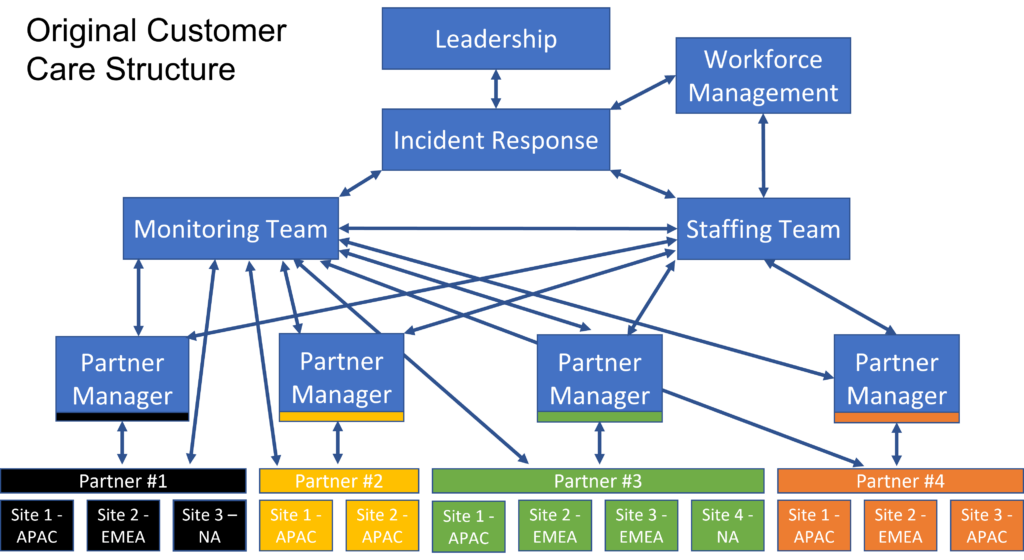
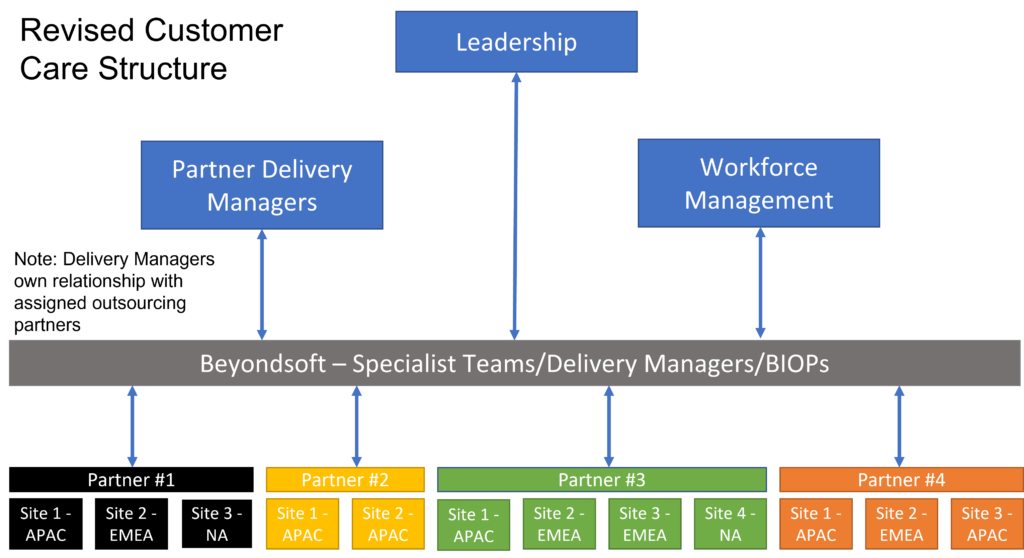
Yet all too often, these teams work in silos, with ad hoc and inefficient communication between the groups–as depicted in the original customer care structure diagram below. This churn generates extra work cycles to overcome gaps in data sharing and hinders the ability to make informed business decisions. Consolidating these functions—such as in the revised customer care structure diagram below—helps streamline operations and ensure all teams understand the current state, including issues and spikes. 

Siloed team structure
The original customer care structure was complicated with inefficient operations and communications.
The revised customer care structure streamlines operations and communications.

4. Data access issues

Quality data provides the foundation for making better, more accurate, and more timely business decisions. When you have limited access to disparate data on disparate systems, it’s hard to get to a single source of truth. As a result, decisions are clunky, requiring manual work to consolidate data across systems. Workforce optimization depends upon the ability to access clean data and derive comprehensive insights across the entire network partner systems. This access can feed into real-time monitoring and surface trends to enable and streamline accurate forecasting.

Solving these issues

Data access, cleanliness, and aggregation

  • Is data accessible and easy to understand?
  • Are you using your data to identify issues?
  • Do you know where your gaps are, and are you addressing them?

Issue identification

  • Do you have clear business requirements and metrics to monitor?
  • Are you automating, or do you have a roadmap?
  • Do you monitor 100% of your business effectively?

Issue resolution

  • Do you have measurable outcomes and are processes tied to these outcomes?
  • Do you have issues resolution metrics in place?
  • Do you have defined processes?

Reporting and processes

  • Are you learning and continually improving?
  • Do you analyze resolved issues to identify opportunities for improvement?
  • Are you combining real-time monitoring and historical reporting to make data-driven decisions?

Assessing and understanding the current state of your global contact center is the first step toward addressing the most common issues impacting workforce optimization. Consider completing this workforce optimization survey, which can give you a high-level view of your data and organizational health.

Why your globally distributed contact center depends on access to clean data

With multiple partner locations worldwide, your globally distributed contact center generates lots of data every day. This data has the potential to help you streamline operations, optimize your workforce, lower costs, boost customer satisfaction, and deliver many other benefits.

If you have access to clean data from all your partners, that is.

Unfortunately, aggregating real-time and historical data from disparate sources—often coming from legacy partner systems riddled with technical debt—can hinder your organization’s ability to leverage that data. Issues might include inaccurate or poorly formatted data or even gaps in data that should be collected but isn’t.

Organizations often work around such issues, hiring teams of individuals who manually compile available data into spreadsheets. They might spend hours cleansing this data before they even start using it. The data is not only incomplete, it’s likely old. Even still, organizations use this better-than-nothing approach to inform critical decisions around staffing, call volume, issue resolution time. It’s a risky approach that also bloats operational overhead.

Beyondsoft has worked with countless enterprise organizations and globally distributed contact centers to help them streamline operations. And we always begin with ensuring data access, cleanliness, and aggregation—itself a massive benefit.

We designed Beyondsoft Intelligent Operations Platform (BIOPs) to help organizations streamline operations and consolidate multiple data streams into a single source of truth through unified, multi-system monitoring, analytics, and workflow automation. BIOPs works with existing tools and cleans and aggregates disparate data sets into meaningful and actionable insights. It also significantly reduces manual efforts and streamlines headcount—a benefit the Microsoft Customer Service and Support business can attest to.

With more than 100 globally distributed call centers, Microsoft needed to increase call center monitoring and eliminate manual processes through automation. Beyondsoft customized and deployed the BIOPs solution to increase call monitoring from just 50% to 100%—all without adding headcount. The solution also automated monitoring, issue detection, alerts, ticket escalation, root cause analysis, and other processes.

Of course, the value of data hygiene and aggregation extends beyond the contact center. Sharing data insights with other departments such as product development and marketing can enable higher quality products and better team coordination around events such as product releases.

The first step, of course, is an assessment of your contact center’s data hygiene as well as other factors to help you gain a holistic understanding of your organization’s needs. We recommend taking this survey as a first step. To learn more about optimizing staffing levels in your contact center, check out our recent article: Improve workforce optimization in the globally distributed contact center.

Improve workforce optimization in the globally distributed contact center

When operating a contact center, it can be challenging optimizing staffing levels. Too many agents on a shift can eat into profits. Too few can negatively impact the customer experience. And when you’re managing staffing levels across multiple, globally distributed contact center partners, the complexity escalates.

Between technical debt inherited from contact center partners, manual forecasting, siloed teams, and suboptimal data access, ensuring the proper staffing levels poses a tremendous challenge for many global organizations. In this article, I’ll share four issues global contact centers face and why taking a holistic assessment of your organization is the first step toward improving workforce optimization.

1. Technical debt

As the saying goes, a chain is only as strong as its weakest link. This same concept applies to technical debt. While your organization may be aware of and working to resolve your own technical debt, you have no control over your subcontractors’ systems. So if any of your contact center partners are working on legacy systems, their technical debt affects your organization. And when you’re working with multiple partners across the globe, technical debt becomes an even bigger problem, impacting data and processes. Therefore, organizations must have a plan to deal with partners’ legacy systems and technical debt.

2. Manual forecasting

Manual forecasting is not only inefficient—it’s not terribly accurate. Say you have 100 contact centers in 30 countries and centrally forecast the number of staff across the global organization—which is precisely what many organizations are doing. This kind of labor-intensive work involves teams of individuals pouring over spreadsheets to analyze and interpret historical data around call center spikes, outages, and product releases. These teams manually combine these variables to develop forward-looking guidance, which is sent to the call centers to inform staffing levels.

It’s a ton of work that uses data that may be heavily influenced by the limitations of partner systems, including technical debt. Cleaning up the technical debt can undoubtedly make forecasting easier. But even better is automating processes to minimize manual work.

3. Siloed teams

All parts of an engine must work to run correctly. When one part breaks or falls out of sync, issues occur. Similarly, team silos substantially reduce efficiency, productivity, and overall effectiveness. Like many contact centers, you likely have several other teams in addition to your workforce forecasting team. For example, you may have a team responsible for interfacing with individual partners, another that monitors partner performance, and another accountable for escalating partner issues. The work of all these teams feeds into accurate forecasting and staffing levels, among other areas.

Yet all too often, these teams work in silos, with ad hoc and inefficient communication between the groups–as depicted in the original customer care structure diagram below. This churn generates extra work cycles to overcome gaps in data sharing and hinders the ability to make informed business decisions. Consolidating these functions—such as in the revised customer care structure diagram below—helps streamline operations and ensure all teams understand the current state, including issues and spikes. 

Siloed team structure
The original customer care structure was complicated with inefficient operations and communications.
The revised customer care structure streamlines operations and communications.

4. Data access issues

Quality data provides the foundation for making better, more accurate, and more timely business decisions. When you have limited access to disparate data on disparate systems, it’s hard to get to a single source of truth. As a result, decisions are clunky, requiring manual work to consolidate data across systems. Workforce optimization depends upon the ability to access clean data and derive comprehensive insights across the entire network partner systems. This access can feed into real-time monitoring and surface trends to enable and streamline accurate forecasting.

Solving these issues

Data access, cleanliness, and aggregation

  • Is data accessible and easy to understand?
  • Are you using your data to identify issues?
  • Do you know where your gaps are, and are you addressing them?

Issue identification

  • Do you have clear business requirements and metrics to monitor?
  • Are you automating, or do you have a roadmap?
  • Do you monitor 100% of your business effectively?

Issue resolution

  • Do you have measurable outcomes and are processes tied to these outcomes?
  • Do you have issues resolution metrics in place?
  • Do you have defined processes?

Reporting and processes

  • Are you learning and continually improving?
  • Do you analyze resolved issues to identify opportunities for improvement?
  • Are you combining real-time monitoring and historical reporting to make data-driven decisions?

Assessing and understanding the current state of your global contact center is the first step toward addressing the most common issues impacting workforce optimization. Consider completing this workforce optimization survey, which can give you a high-level view of your data and organizational health.

From cloud migration to automation: Insights to inform your 2022 IT planning

As we bid farewell to 2021 and peek around the corner at 2022, many of us are putting plans in place to increase efficiencies, boost product and service quality, or expand into new markets. To help inform your IT planning, we’ve put together a quick collection of articles. To find out how Beyondsoft can help your organization accelerate transformation in 2022, give us a call.

Increase performance, scalability, and cost-efficiency with a cloud migration

Migrating to the cloud offers benefits ranging from decreased licensing and storage costs to improved performance and scalability. A move to the cloud also positions organizations to advance their data analytics and even drive new revenue streams. But, of course, ensuring a successful data migration requires detailed planning and preparation as well as the right data migration strategy.

If you’re looking to migrate to the cloud, check out these helpful insights.

Migrating to the cloud? You need a cloud assessment

Migrating to the cloud is easier said than done, particularly for larger organizations. A cloud assessment can help ensure your strategy aligns with business objectives, understand and mitigate risks, and build a realistic roadmap.

Choosing the right data migration strategy

This article explores four common data migration strategies, including their advantages and how a data migration assessment can help you make the right choice.

Demystifying data migrations: Understanding the lift and shift

The right data migration strategy can save you time and money while increasing performance. This article explores the pros and cons of the lift-and-shift data migration strategy.

How a upsertable data lakes can simplify the data lake journey

Thinking about migrating to a data lake? Upsertable data lakes like Delta Lake and Hudi can ease your transition from traditional SQL databases to a data lake architecture. In this article, learn about the pros and cons and how upsertable data lakes reduce complexity.

Drive greater quality and productivity through automation

By taking advantage of technologies like artificial intelligence (AI) and machine learning (ML), organizations across every industry are reaping the rewards of automation, including improved efficiency, productivity, and profitability and reduced exposure to human-caused mistakes. If you’re planning to embrace the advantages of automation in 2022, be sure to read these blog posts.

Do yourself a favor: audit before you automate

When it comes to automation, complexity lurks under the hood. In this article, we explore why you should always audit before you automate.

Say hello to productivity with intelligent automation

See how intelligent automation technologies like AI can help your business eliminate manual processes to drive productivity, quality, and profitability.

Considerations for designing a test automation strategy

A good test automation strategy can save time and money and boost quality. Keep these considerations in mind when planning your strategy.

Harness the power of data analytics

AI and ML are also helping organizations access a treasure trove of data and glean actionable insights that position them to compete at a higher level.

How machine learning unlocks data to target customers & drive sales

In this article, discover how machine learning can help your e-commerce business convert data you already have into actionable insights and predictions to expand sales.

Position your organization to accelerate success

The global market constantly fluctuates and evolves—and organizations must also evolve. But aligning your teams—including globally distributed service center partners—to support business needs and drive growth takes the right expertise combined with the right technologies. Use these articles to position your teams for increased success.

Take a continuous improvement approach to organizational design

Keep your teams functioning at their best by taking a continuous improvement approach to organizational design. This article explores some benefits and best practices that have helped us grow successful, global teams.

Streamline operations across globally distributed contact centers

In this article, find out how machine learning streamlines the management of globally distributed contact centers.

Insights to help organizations manage globally distributed customer support partners

Ensuring a consistent customer experience and seamless operations across globally distributed customer support partners can be challenging. Get insights to help you streamline how you manage multiple partners.

Scale quickly and drive efficiency through outsourcing

Whether you need specialized talent or an entire service desk team, outsourcing can provide you with the answers you need to scale your organization and increase capacity while keeping your staff focused on your core business. Find out how outsourcing can help you achieve business goals without hiring additional people.

What’s the right fit: Professional services, managed services, or staff augmentation?

Discover how professional services, managed services, and staff augmentation compare—and which is the right service model for your business.

Tap skilled IT engineers without adding headcount

To stay competitive, organizations must embrace innovation. Find out how to access highly skilled IT engineers without increasing headcount.

Four signs that you need a managed services provider

Wondering if a managed services model is the right fit? Here are four signs that you need a managed services provider.

6 reasons why you should outsource your service desk

If you’re looking to expand, find out why you should consider outsourcing your service desk and what to look for when choosing a service provider.

Rely on a trusted, global technology partner

As a global IT partner, Beyondsoft thrives on innovating scalable solutions that solve customer challenges and accelerate business. In fact, both medium-sized enterprises and Fortune 100 companies rely on Beyondsoft to help them transform business–whether they’re migrating to the cloud, streamlining through DevOps, automating through AI and machine learning, or putting powerful predictive analytics to work.

To learn more about how we can help you accelerate business in 2022, be sure to contact us.

Take a continuous improvement approach to organizational design

If there’s one thing you can count on, it’s change. As time marches forward, technologies evolve, markets shift, new competitors arise, people come and go. These and other ongoing changes can have substantial impacts to your organization—whether you notice the effects right away or not.

Case in point: let’s say your business has expanded internationally and you’re getting ready to launch a new line of products. To gear up, your business has undergone a major re-organization to align teams to more effectively support the accelerated growth. As a result of the re-org, your teams are positioned for optimal success, and you’re already seeing the  results, including increased efficiency and productivity, improved quality, and best of all, skyrocketing revenues.

Your hard re-org work has paid off in spades! Then a year or two goes by, and you lose a few key employees. Their more experienced coworkers take on expanded roles and try to pick up the slack, but now they’re falling behind on deliverables and it’s taking a lot of time to onboard new employees. People are burning out. Customer complaints are stacking up due to a bug that went out in the latest software release. To complicate matters, your main competitor just released a new product with killer incentives, and suddenly business growth has slowed down. That major re-org you did is quickly becoming obsolete and you’re faced with yet another overhaul.

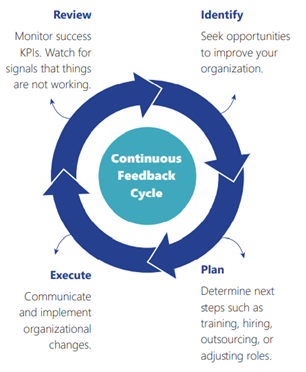
The fact is that rarely do we get things 100% right the first time. And that includes restructuring teams. Taking a continuous improvement approach to organizational design helps you work out the kinks and tackle challenges as they come. Below, I’ll share what a continuous improvement cycle looks like when it comes to organizational design, its specific advantages, and some best practices for setting up a continuous feedback loop.

What a continuous improvement approach to organizational design looks like

Major re-orgs take a lot of time and planning. They can be incredibly disruptive, especially to employees who may grow frustrated with upheaval and uncertainty. Furthermore, when you do a major re-org, there are often considerable business problems that have been festering in the background, eroding productivity, efficiency, and often, employee morale.

But a continuous improvement cycle enables you to address business changes and fluctuations incrementally. Rather than waiting to make a major re-org once problems come to a head, your organization evolves with your business. Instead of thinking about your org chart once a year during planning, you’re always looking at ways to optimize your teams. You’ve got listening processes in place. You’ve established tracking systems. You’re checking in with your employees. You’re making changes as you go.

Benefits of a continuous improvement cycle

A continuous improvement approach to organizational design offers many benefits, including greater agility, improved productivity, higher quality, better customer satisfaction scores, and happier, more empowered employees.  

In fact, empowerment, in my opinion, is one of the most significant benefits of a continuous improvement cycle. Employees who are put into positions that maximize their talents and enable career growth feel more empowered to develop new, innovative, more efficient ways to get work done. You create centers of excellence that foster a growth mindset, where people are invested in the business and believe that the business is invested in them.

How to set up a continuous feedback cycle

Rather than a linear, one-and-done approach, a continuous feedback cycle never ends. The four components—review, identify, plan, and execute—help you make ongoing changes and build centers of excellence.

Continuous improvement feedback cycle for org design

Review: The review phase is all about establishing meaningful KPIs and then tracking against those KPIs regularly—whether that’s weekly, monthly, quarterly, or annually. KPIs will vary based on your business but might include revenue, expenses, customer and employee satisfaction, quality, on-time delivery, and more. Based on these KPIs, watch for signals that things are not working as expected.

Identify: By reviewing KPIs regularly, you’ll be able to spot issues, patterns, and trends more quickly. By surfacing issues early on, you can identify root causes and mitigate them before they become endemic and cause broad repercussions. By course-correcting along the way, you side-step broader business impacts.

Plan: Once you’ve identified the issue and the root cause, take steps to get things back on track. Determine the next steps, whether that’s training staff members, redistributing or outsourcing workloads, or making updates to internal processes. Circulate your plan to gather feedback and perspective from your leadership team and members of your business unit so that you not only identify gaps and risks but that you receive buy-in.

Execute: Once you’ve got a plan in place, communicate and implement your changes. Make sure staff members understand why you are making changes and what the expected outcomes are. Continue to solicit their feedback following the changes and update your KPIs if necessary to understand the impact and to learn if you need to modify your plan.

What a continuous improvement approach to organizational design looks like in practice

Going back to our original example, instead of taking a set-it-and-forget-it approach, you’ve got KPIs in place. You’re monitoring team productivity, product quality, customer satisfaction scores, and other desired metrics every month. You’re checking in each quarter with employees to understand what’s working well and what isn’t and balance out their workloads. You’re conducting a twice-annual anonymous employee survey to track satisfaction scores and to seek opportunities to improve. As each issue comes up, you tackle it right away. And to your relief, employees are happier and more productive. Your continued efforts are helping your business achieve its goals.

Taking a continuous improvement approach to organizational design sets you up for greater success in the long term. To learn more, please take time to review our white paper: Growing Global Teams: A Best Practice Approach to Organizational Design. Need help scaling and optimizing your team? With 32 delivery centers across five continents, Beyondsoft can help, whether you need business process outsourcing, professional services, consulting, or other support. Please feel free to contact us today.