Four advantages of IT managed services you might not know about

Keeping pace with the fast-evolving technology landscape while maintaining your applications and ensuring your systems are secure, scalable, and efficient can be daunting, particularly for organizations with limited resources. And few businesses have the budget to hire experts with every emerging skill set they require. That’s where an IT managed services provider can help.

As a strategic partner, an IT managed services provider supplies a dedicated team of professionals with specialized skills and knowledge to oversee one or more day-to-day parts of your business, such as IT operations support, application management, or a global contact center. As a result, you gain access to a pool of experts, the latest technologies, and industry-leading processes and best practices without breaking the budget. You also free up your in-house experts to focus on accelerating your business.

But did you know that there are lots of other benefits of an IT managed services provider? Below, I’ve shared some of the lesser-known advantages.

1. Work smarter with generative AI

Managed services providers that integrate generative AI into their service models can help you unlock new levels of efficiency and productivity. Generative AI can help optimize resource allocation, automate routine tasks, and improve decision-making processes. In addition, it can analyze data to identify patterns, trends, and security threats and predict potential issues and anomalies. Such insights can inform preventative measures, ultimately reducing disruptions and improving system reliability.

Furthermore, generative AI such as ChatGPT can power chatbots, using natural language processing capabilities to respond to user queries, saving time and improving customer satisfaction.

2. Improve financial predictability and accountability

With managed services, you get a clear and predictable cost structure, allowing you to budget and plan more effectively. This can be particularly valuable if your business has variable workloads or seasonal demand. Managed services providers can help your organization identify areas for cost optimization and greater efficiency to maximize your IT investment and increase ROI. Furthermore, engaging with an IT managed services provider enables you to allocate internal resources more effectively and make more targeted investments in staffing and training.

3. Strengthen security and compliance

Partnering with a reliable IT managed services provider can enhance your organization’s security measures. You gain access to a team of professionals with expertise in the latest security threats, industry standards, and best practices, which may not be available in-house. They can recommend strong security measures by deploying advanced firewalls, intrusion detection and prevention systems, and automated updates and patches. Moreover, they can use advanced monitoring tools and technologies to respond to security threats immediately and take swift action to minimize the impact and address vulnerabilities.

Additionally, a managed service provider can help you meet industry-specific compliance and regulatory requirements, such as GDPR, SOX, and HIPAA. They can help you identify gaps and areas of non-compliance and recommend and implement the necessary controls and measures your business needs to ensure compliance.  

4. Enhance business availability

Increased business availability is another advantage of partnering with a great IT managed service provider, ensuring your applications and data are available when needed. Proactive monitoring helps prevent system downtime, performance bottlenecks, and other potential issues. When issues do occur, your managed services provider can quickly diagnose and resolve issues to minimize the impact on operations. They can also perform regular maintenance and backups to enhance system availability and reliability.

Furthermore, your managed services provider can help you develop robust disaster recovery and business continuity plans and processes. They can identify gaps and issues and create backup and recovery strategies, incident response procedures, and system redundances to ensure maximum system uptime.

Trust Beyondsoft IT managed services for your business

As a global, full-service IT provider, Beyondsoft has helped countless organizations accelerate business, including Brazil-based veterinary care center, WeVets. Beyondsoft takes a data-driven approach to IT managed services, leveraging advanced automation technologies and AI to drive greater efficiency, productivity, and impact. To learn more, contact us today.
Optimize your contact center knowledge base to drive efficiency

If you manage a contact center, you’re always on the lookout for opportunities to reduce average handle time (AHT) and increase customer satisfaction. But have you assessed your contact center knowledge base? Experienced agents and new hires alike rely on your knowledge base to address customer inquiries with speed and accuracy. Their ability to find clear answers quickly—regardless of experience—improves AHT while also reducing errors and customer call backs. Start with these four questions to uncover opportunities to optimize your contact center knowledge base and improve AHT.

Is the writing style concise and consistent?

A challenge contact centers face is the varying levels of agent experience. Tenured agents rely less on detailed instructions than new agents, although they still need to find critical information quickly. Newer agents appreciate step-by-step details, but don’t want to sift through long-winded blocks of text. Which means you need to adopt a writing style with the right level of detail to satisfy the needs of both.

  1. Keep titles and headings short but descriptive. Use simple, consistent language and include target keywords.
  2. Likewise, use plain, consistent language across all articles. For example, stick with the same, familiar commands throughout, such as “click” versus “select.”
  3. Choose concise words, such as “use” over “utilize” and “start” over “commence.”
  4. Trim redundant and other unnecessary words. For example, change “two different methods” to “two methods.”
  5. Keep sentences short, putting new ideas into separate sentences.
  6. Choose active voice over passive voice whenever possible.

Are the articles (or user interface) visually user-friendly?

In addition to a concise and consistent writing style, make knowledge base articles visually scannable and easy to navigate. User-friendly navigation within articles helps agents find what they need faster.

  1. Use white space to separate information visually. Too much information crammed onto the page can make information difficult to find.
  2. Use consistent, accessible heading styles to make scanning easier.
  3. Number steps and keep them short.
  4. Bold key commands and options, such as this example: “Go to Home > Styles, and then select Heading 1.”
  5. Make critical information easy to identify on the page.
  6. Ensure consistent navigation across knowledge base articles.

Do articles support contact center workflow?

To optimize your contact center knowledge base, consider the agents’ workflow. Tap data insights around typical call flow and agents’ next steps to understand workflow needs. Ensure articles align with workflows, so agents can resolve calls more quickly.

  1. Put priority, need-to-know information first. For example, ensure that critical policy, cautionary, and other crucial information appear first, with supporting detail after.
  2. Provide links to commonly accessed, related articles and next steps.

Does functional design enhance efficiency?

Functional design elements can enhance AHT when used strategically. Apply functional design elements such as decision trees and popups to support efficiency while striking a balance to avoid unnecessary noise.

  1. Use decision trees for scenario-based processes. For example, if a process varies based on caller location, use a decision tree to direct the agent to the correct article.
  2. Popup windows can be great for removing clutter on screen. But they can also be annoying and occasionally, easy to miss. Use popup windows selectively and ensure they don’t block other content.
  3. Drop-downs and expansion elements help save space but should be reserved for supplementary information. Keep critical information visible to ensure it gets read.

Get a no-cost contact center knowledge base assessment

As a trusted global managed services and service desk provider, Beyondsoft has comprehensive experience implementing and operating global contact centers for some of the world’s leading companies, including Microsoft. Our consultants have deep expertise across verticals in building and managing effective knowledge bases. If you’re interested in seeking ways to optimize your contact center knowledge base, reach out to us for a brief, no-cost assessment.

A better CX starts with automated call center operations

In a world where one-third of customers will abandon a beloved brand after a single negative experience,[i] every touchpoint matters. So, what matters most? According to 80% of US consumers, speed, convenience, and friendly, helpful service are top priorities.[ii] And those priorities depend upon automated call center operations.

Yet even as brands seek to delight customers across touchpoints, call centers still need to monitor queues, right-size staffing, and meet service-level expectations. So, before you begin building enticing new experiences, streamlining and perfecting the backend processes should be priority number one.

In this article, I want to explore how streamlined and automated call center operations can free up your organization to focus on elevating the customer experience (CX).

The high stakes of low-value activities

The reality is that backend call center operations are an expectation of doing business–not a differentiator. Short wait times and quick resolutions elicit little customer feedback. It’s not until a customer waits longer than expected or comes across an unhelpful agent that a customer takes notice.

So, what comprises high-stakes, low-value activities? Here are a few examples:

  • Monitoring queues and sites for issues that could lead to higher wait times.
  • Manually identifying the root cause of an issue and then working with operations teams to resolve it.
  • Taking data from multiple sites or systems and manually combining and reviewing it to make staffing and forecasting decisions.

When done well, these necessary backend activities are invisible to the agent and the customer alike. But, when not done well, these activities erode the customer experience. While vital, ultimately, these activities don’t drive value in the customer experience.

Finding more time to elevate the customer experience through automated call center operations

When you spend your time keeping the lights on, it can be hard to find time to delight customers with upgraded experiences. As such, it is important to implement ways to streamline and automate high-impact, low-value processes so that they require as little human effort as possible.

Automated call center operations can help your organization off-load must-do work and devote more time implementing the things that will accelerate business and customer loyalty. However, high-value activities depend on streamlining low-value activities. To that end, I’ve listed some examples below.

This high-value activity depends on… optimizing this low-value activity
Implementing tools, workflows, training, and processes that empower agents to delight customers at every interaction.   Monitoring queues and sites for issues that could lead to higher wait times.
A/B testing different customer support flows to see which channels (or a combination thereof) resolve which types of customer issues most efficiently and effectively and using this information to make sure the customer gets to the right place. Manually identifying the root cause of a routing issue and then working with operations teams to resolve it.
Implementing asynchronous communication to avoid having to completely restart the customer interaction every time there’s a distraction.   Effectively monitoring 100% of your incoming channels to ensure customers get where they need to be to have their issue resolved.
Building out more effective, quality programs to ensure all agents get the coaching and support they need to delight customers. Taking data from multiple sites and/or systems and manually combining and reviewing it to make staffing/forecasting decisions.

Buttoning up the low-value activities through automation and managed services liberates your teams to focus on high-value, high-impact activities. As a result, such activities can truly differentiate the parts of your operation that your customer interacts with.

Contact Beyondsoft for a no-cost assessment

Beyondsoft takes a data-driven approach to managed services. We use advanced automation technologies to make your globally distributed contact center operate more effectively and efficiently. Furthermore, our Beyondsoft Intelligent Operations Platform (BIOPs) leverages decades of experience in analytics, artificial intelligence, and machine learning. BIOPs eliminates manual processes and interventions, increases efficiency, and helps you scale more effectively.

To explore ways to improve the customer experience, reach out to us for a no-cost assessment.


[i] PWC (2018) “Experience is everything,” available at: https://www.pwc.com/us/en/zz-test/assets/pwc-consumer-intelligence-series-customer-experience.pdf (accessed April 13, 2022).

[ii] PWC (2018) “Experience is everything,” available at: https://www.pwc.com/us/en/zz-test/assets/pwc-consumer-intelligence-series-customer-experience.pdf (accessed April 13, 2022).

How reporting improves process refinement in the globally distributed contact center

We’ve recently been exploring the importance of access to clean, quality data in your globally distributed contact center. Real-time data insights drive better business decisions, increase productivity, and elevate service quality and customer satisfaction rates. Data access and aggregation can help you optimize your workforce, inform contingency planning. And in our most recent article, we learned how metrics can improve issue identification and resolution.

In this article, I’ll share why access to quality data is essential to reporting and process refinement.

Metrics grounded in reality

Metrics help organizations proactively improve performance when aligned with business decisions and business needs. Metrics based on historical data and grounded in reality help inform thresholds that trigger alerts upon detection of potential issues. In fact, the most meaningful thresholds are dynamic, accounting for a variety of circumstances and not just the worst-case scenario.

Here’s what I mean: let’s say your target wait time is less than two minutes, and you’ve set your threshold based on this number. On a slow day, you’ll likely meet your target, and no alerts will be triggered. However, you may not realize that despite lower call volumes, actual wait times still exceed 90 seconds— longer than they should be given current staffing levels. Without meaningful, dynamic thresholds, it’s easy to miss factors impeding performance and opportunities to enhance service levels.

Additionally, with the right reporting tools, you can use data to make business decisions at a higher level — not just tactical ones on the ground. In other words, instead of using data to put out the fire, you can use data to fireproof the house.

For example, perhaps you’re not hitting wait time targets. Without data insights and detailed reporting, you might assume that you have a staffing issue, so you bring 30 more agents online. But with robust reporting capabilities, you can dig into the data and surface trends and determine if you truly have call volume spikes or if something else has gone amiss, such as a system that gets taken offline for regular maintenance at an inopportune time — something easily remedied through a process change.

A data-driven approach to process refinement

Robust reporting can be beneficial for ongoing process refinement. It can help you assess process effectiveness and identify upstream or downstream changes that impact process efficiency. For instance, you might have a process that’s been in place for years. Only through reporting might you see that upstream changes, such as the introduction of chat support, have rendered this process inefficient or obsolete.  

The ability to report on issues experienced over a period of time and the actions taken to resolve those issues can provide insight into recurring patterns and potential process shortcomings. Without adequate historical reporting, you may not realize that the same issue keeps popping up—and that your existing process is addressing a symptom rather than a deeper cause.

With high-value reporting, you can make better business decisions and ensure your processes evolve to meet those business needs.

A more intelligent solution

Data aggregation, reporting, and process refinement across the globally distributed contact center comprise a few reasons we developed the Beyondsoft Intelligent Operations Platform (BIOPs). Part of our managed service offering, BIOPs provides a unified solution for multi-system monitoring, analytics, and workflow automation across disparate systems. It helps to reduce manual processes while allowing us to glean metrics and insights that inform decisions around staffing, issue detection, and resolution—all while reducing the need for human intervention and headcount. 

For a more holistic understanding of your organization’s strengths and weaknesses in this area, I highly recommend completing this free survey.

Improving issue identification and resolution in the globally distributed contact center

As discussed in Why your globally distributed contact center depends on access to clean data, quality data across your operation underpins the effectiveness of your contact center. Real-time data insights can drive better business decisions, increase productivity, and elevate service quality and customer satisfaction rates.

But did you know that quality data also can help you find and resolve issues faster—and even prevent some from ever happening? In this follow-up post, I’ll share how globally distributed contact centers can leverage data to improve issue identification and resolution.

Intelligently designed metrics

The ability to set thresholds is vital to issue identification and resolution. And this means using intelligently designed metrics to define what constitutes an issue.

For example, let’s say that you’re a cellular provider. Your service level agreement specifies that 95% of calls are answered within five minutes, and 90% of issues are resolved in the first call. To ensure you meet these targets, you need to know when you’re at risk of missing them. Intelligently designed metrics enable you to define the thresholds that alert you to potential issues. 

Automated issue identification

If you’re doing manual work to identify issues, you’re overdue for some built-in automation. Not only is automation more efficient than having humans perform this work, it’s also far more timely and accurate.

Case in point: say an issue pops up in one of your remote centers. The responsible person has stepped away from their desk and doesn’t see it until 20 minutes later—or worse, misses the issue altogether, negatively impacting service levels.

Automation, on the other hand, never steps away from the desk. And while a human might misinterpret data and send teams to chase the wrong issue, automation is far more likely to make the proper diagnosis.

Monitoring 100% of data

Not only do you need access to data across your call centers—you must monitor every system that feeds into your ecosystem.

Going back to the cellular service provider example, let’s say you suddenly see a massive spike in call volumes. Your call center data is clean, and you’re scrambling to pinpoint the cause. Meanwhile, unbeknownst to you, the retail point-of-sale systems are down across the west coast, prompting in-store representatives to call into customer care to activate phones. Having access to that data would have saved you valuable time.

Defining issue resolution

When tackling an issue, it’s important to know that you’ve addressed the root of the problem and not just a symptom. For example, perhaps you resolved a spike in call volume with additional agents. But have you determined what caused the spike and will it happen again? This is why you need to establish clear metrics that define issue resolution—such as recurrence within a specific timeframe.

You also need very clear processes on how to achieve resolution. The most successful organizations have a runbook that saves them the time and frustration of the trial-and-error approach. They have a checklist that they follow immediately if something goes wrong, much like an airplane pilot. Clear, repeatable processes drive efficiency.

Discover opportunities to improve issue identification and resolution

Operating a globally distributed contact center has become increasingly complex. Access to quality data across the business streamlines your ability to identify and resolve issues and meet service level requirements. For a more holistic understanding of your organization’s strengths and weaknesses in this area, I highly recommend completing this free survey.

5 tips to help your brand earn customer trust

Making a trustworthy impression on today’s consumers is more challenging than ever. Customers must navigate oversaturated markets and sift through marketing claims to discover the products and services that best meet their needs. So, it’s unsurprising that once they find the “right” company, they’re oftentimes still skeptical. Here are five ways to earn customer trust and increase your business’s credibility.

1. Provide excellent customer service

In the age of same-day delivery and chatbots, customers have come to expect a stellar experience. However, when customers are dispatched through multiple customer support channels without a quick resolution (or no response at all), they quickly lose faith.

According to Forrester Research, 77% of customers say that valuing their time is the most important thing a company can do to provide good online support. So, make sure that your customer service representatives are readily available, whether through phone, email, social media, or chat support. Look for opportunities to streamline support processes through automation. And leverage technology to help minimize the number of issues that come up.

2. Build mindshare with engaging webinars

Sharing your expertise through a webinar helps build brand awareness and increase trustworthiness. A webinar provides a valuable service to customers and prospects. It also demonstrates that you have mindshare in your field. You can even enhance your webinar by partnering with a guest speaker from your industry or target market. Leveraging your relationships with key clients or analysts in your field can help increase visibility and generate leads. Plus, compared to other marketing strategies, leads generated through webinars are more credible since attendees are often more interested in what you have to say and offer.

3. Optimize your website

According to the eCommerce Foundation, 88% of consumers research product information before purchasing online or in-store. So, it’s essential to deliver a great digital experience. Review website traffic and examine bounce rates. If people click through to your site to leave immediately, something is wrong. Either your website is driving them away, or your website is turning up in unrelated searches.

When evaluating your website, focus on the user experience. Is it easy to navigate, and can users easily find what they’re looking for? Are pages uncluttered with clear headings and plenty of white space? Are pages optimized for search engines? Is content relevant to users’ online searches? If your website is missing the mark, consider hiring an expert to make the most of your online presence.

4. Highlight testimonials

When was the last time you purchased something without looking at a review? Today’s buyers are looking for reviews, too, but they can come in several forms. Customer reviews—like the ones you’d see on Amazon—are critical to consumers. In fact, 88% of consumers trust online reviews as much as personal recommendations. Consider investing in a customer experience platform. These platforms create automated touchpoints with your customers, including asking satisfied customers to review your product or service.

Case studies, on the other hand, are meant to show real-life customer success stories that demonstrate a return on investment (ROI). Identify customers with whom you’ve had a great business relationship and evaluate how your product or service has impacted their business operations. If the results are strong, ask them to be part of a case study.

5. Validate marketing claims

Validation from independent third parties helps establish credibility with customers. Consider pursuing relevant industry certifications or other accreditations to differentiate your product. Additionally, validate marketing claims with an independent organization to assure prospects that your products perform—or outperform—the way they’re supposed to. Marketing claims validation can run the gamut from exploratory consultations to thorough hands-on testing and complement testimonials by validating specific aspects of your product or service.

In a saturated global market, brand credibility is vital. Earn customer trust by providing stellar customer support, demonstrating mindshare through webinars, optimizing your online presence, leveraging testimonials, and validating marketing claims.  

What global contact centers can learn from the Black Thunder mine disaster

Nary a day goes by that we don’t hear about a disaster somewhere in the world—whether man-made or natural—impacting hundreds or even thousands of lives, livelihoods, and business operations. Small or large, disasters run the gamut from floods and fires to network outages, cyberattacks, and supply chain disruptions.

Take, for example, the 2008 Black Thunder mine accident. Based in Wyoming, this massive coal operation planned to install a 250-ton, 260-foot tube designed to convey coal to a silo for loading trains. The mammoth structure would be mounted by a crane atop pylons over three railroad tracks—tracks traveled by 80 trains every day, delivering coal to power plants across the US.

But on the day of the installation, the unexpected happened: the crane collapsed, dropping the tube across the tracks. Because three workers were injured, the US Mine Safety and Health Administration (MSHA) wanted to conduct an investigation in three days’ time and insisted that nothing be moved from the tracks–a delay that would cause substantial supply chain consequences.

Thanks to robust coordination with the mine, BNSF Railway VP of Engineering David Freeman developed contingency plans, including putting repair crews with four large tractors on standby at the site. Freeman convinced the MSHA to allow crews to shift the tube off the tracks without disturbing evidence. The operation took just 21 minutes—and soon, the trains began running again.

Each year, disasters like the Black Thunder mine incident and other unexpected events knock global businesses off course. Such incidents frequently impact globally distributed contact centers. Below I lay out some insights and takeaways from the Black Thunder mine disaster that global contact centers can apply to their own contingency planning efforts.

Expect the unexpected

Organizations must establish contingency plans to ensure business continuity—a concept BNSF took to heart. BNSF had built a strong relationship with the Black Thunder Mine teams and was able to gain visibility into the operation and provide inputs. This collaborative relationship enabled BNSF to proactively plan for the unexpected, putting teams on standby and processes in place to respond quickly. When disaster struck, they executed their contingency plan and got trains moving that very day.

Takeaways for contact centers

  • Think through plausible emergency scenarios for your globally distributed contact center, and then build contingency plans around these scenarios.
  • Overprepare your contact center communications network to ensure appropriate and immediate action against disruptions.
  • Coordinate across the entire organization to ensure everyone understands their role and required actions.
  • Establish clear protocols to extract and manage constant data thresholds from all parties involved.
  • Define a precise series of actions and metrics to know when an issue is resolved and normal operations can resume.
  • Incorporate processes to assess root cause and success at contingency plan execution.

Leverage data and analysis

Planning for and detecting issues in real-time can save precious time and ensure a better customer experience. BNSF used data to inform their contingency planning and response efforts and assess a disaster’s potential impact on deliveries and end customers. They also relied on data to know what it would take to clear the railway of obstructions, fast-track repairs, and coordinate with federal agencies.

Takeaways for contact centers

  • Assess and resolve technical debt, data gaps, and data access issues across your global contact center partners.
  • Aggregate and leverage real-time data from contact center partners and other departments across your business to monitor and predict call volume, staffing levels, inbound events, and more.
  • Analyze data trends to predict and (potentially avoid) possible events and quickly detect events already underway.
  • Use real-time metrics to trigger contingency measures and troubleshoot and resolve issues. Ensure that data is detailed enough to understand what happened, so you can take steps to minimize recurrence. 
  • Finally, use data to measure success and inform process improvements for the future.

Have clear visibility across your interconnected global contact center

BNSF had built a robust communications network both internally and externally, giving them clear visibility into the breadth and impacts of the construction plan. Their collaborative relationships with key stakeholders and deep project visibility enabled them to plan to identify potential issues and response scenarios that didn’t depend upon other parties.

Takeaways for contact centers

  • Gain clear visibility across your interconnected global contact center to make faster decisions regarding contact center management and health.
  • Break down silos within the business to streamline operations and keep everyone on the same page.
  • Establish a centralized response plan that doesn’t rely upon any single partner or stakeholder.

Disasters and other unexpected events happen. Preparation is key. Anticipating plausible emergencies, using data to your advantage, and having clear visibility of your interconnected global contact center will help you respond quickly, protect your business, and limit impacts. To assess the health and operational efficiency of your globally distributed contact center, complete this short survey

Beyondsoft Consulting Opens Managed Services Operations Center in Costa Rica

When operating a contact center, it can be challenging optimizing staffing levels. Too many agents on a shift can eat into profits. Too few can negatively impact the customer experience. And when you’re managing staffing levels across multiple, globally distributed contact center partners, the complexity escalates.

Between technical debt inherited from contact center partners, manual forecasting, siloed teams, and suboptimal data access, ensuring the proper staffing levels poses a tremendous challenge for many global organizations. In this article, I’ll share four issues global contact centers face and why taking a holistic assessment of your organization is the first step toward improving workforce optimization.

1. Technical debt

As the saying goes, a chain is only as strong as its weakest link. This same concept applies to technical debt. While your organization may be aware of and working to resolve your own technical debt, you have no control over your subcontractors’ systems. So if any of your contact center partners are working on legacy systems, their technical debt affects your organization. And when you’re working with multiple partners across the globe, technical debt becomes an even bigger problem, impacting data and processes. Therefore, organizations must have a plan to deal with partners’ legacy systems and technical debt.

2. Manual forecasting

Manual forecasting is not only inefficient—it’s not terribly accurate. Say you have 100 contact centers in 30 countries and centrally forecast the number of staff across the global organization—which is precisely what many organizations are doing. This kind of labor-intensive work involves teams of individuals pouring over spreadsheets to analyze and interpret historical data around call center spikes, outages, and product releases. These teams manually combine these variables to develop forward-looking guidance, which is sent to the call centers to inform staffing levels.

It’s a ton of work that uses data that may be heavily influenced by the limitations of partner systems, including technical debt. Cleaning up the technical debt can undoubtedly make forecasting easier. But even better is automating processes to minimize manual work.

3. Siloed teams

All parts of an engine must work to run correctly. When one part breaks or falls out of sync, issues occur. Similarly, team silos substantially reduce efficiency, productivity, and overall effectiveness. Like many contact centers, you likely have several other teams in addition to your workforce forecasting team. For example, you may have a team responsible for interfacing with individual partners, another that monitors partner performance, and another accountable for escalating partner issues. The work of all these teams feeds into accurate forecasting and staffing levels, among other areas.

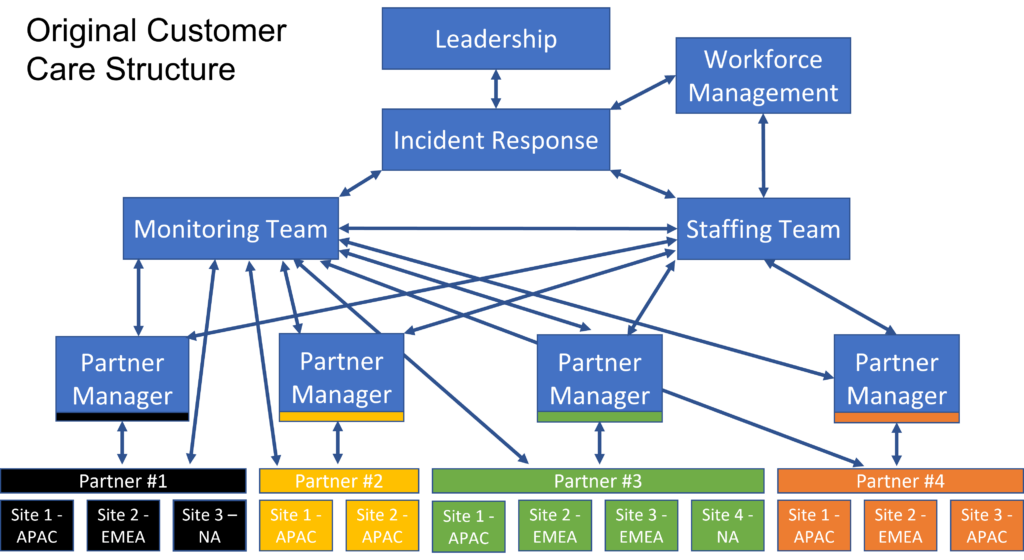
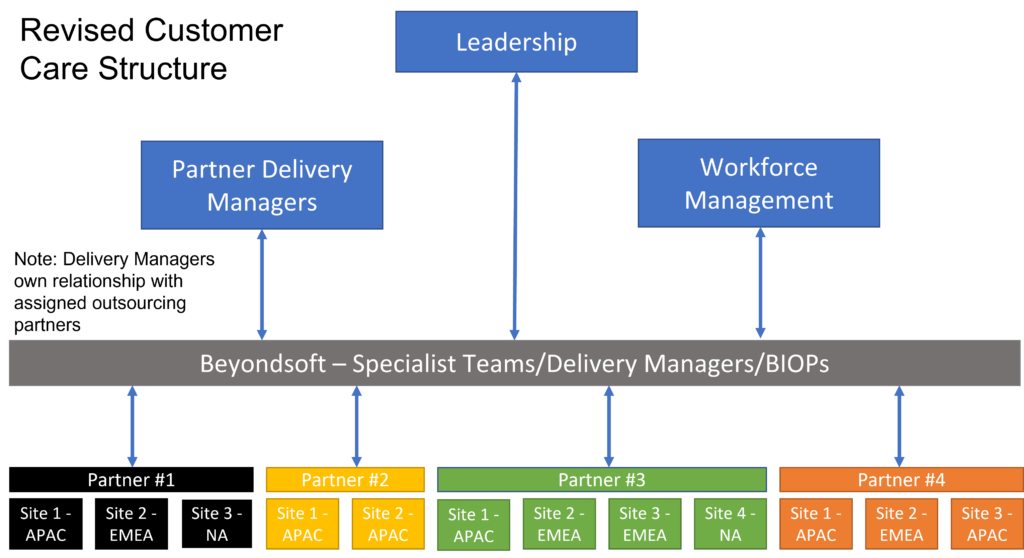
Yet all too often, these teams work in silos, with ad hoc and inefficient communication between the groups–as depicted in the original customer care structure diagram below. This churn generates extra work cycles to overcome gaps in data sharing and hinders the ability to make informed business decisions. Consolidating these functions—such as in the revised customer care structure diagram below—helps streamline operations and ensure all teams understand the current state, including issues and spikes. 

Siloed team structure
The original customer care structure was complicated with inefficient operations and communications.
The revised customer care structure streamlines operations and communications.

4. Data access issues

Quality data provides the foundation for making better, more accurate, and more timely business decisions. When you have limited access to disparate data on disparate systems, it’s hard to get to a single source of truth. As a result, decisions are clunky, requiring manual work to consolidate data across systems. Workforce optimization depends upon the ability to access clean data and derive comprehensive insights across the entire network partner systems. This access can feed into real-time monitoring and surface trends to enable and streamline accurate forecasting.

Solving these issues

Data access, cleanliness, and aggregation

  • Is data accessible and easy to understand?
  • Are you using your data to identify issues?
  • Do you know where your gaps are, and are you addressing them?

Issue identification

  • Do you have clear business requirements and metrics to monitor?
  • Are you automating, or do you have a roadmap?
  • Do you monitor 100% of your business effectively?

Issue resolution

  • Do you have measurable outcomes and are processes tied to these outcomes?
  • Do you have issues resolution metrics in place?
  • Do you have defined processes?

Reporting and processes

  • Are you learning and continually improving?
  • Do you analyze resolved issues to identify opportunities for improvement?
  • Are you combining real-time monitoring and historical reporting to make data-driven decisions?

Assessing and understanding the current state of your global contact center is the first step toward addressing the most common issues impacting workforce optimization. Consider completing this workforce optimization survey, which can give you a high-level view of your data and organizational health.

Why your globally distributed contact center depends on access to clean data

With multiple partner locations worldwide, your globally distributed contact center generates lots of data every day. This data has the potential to help you streamline operations, optimize your workforce, lower costs, boost customer satisfaction, and deliver many other benefits.

If you have access to clean data from all your partners, that is.

Unfortunately, aggregating real-time and historical data from disparate sources—often coming from legacy partner systems riddled with technical debt—can hinder your organization’s ability to leverage that data. Issues might include inaccurate or poorly formatted data or even gaps in data that should be collected but isn’t.

Organizations often work around such issues, hiring teams of individuals who manually compile available data into spreadsheets. They might spend hours cleansing this data before they even start using it. The data is not only incomplete, it’s likely old. Even still, organizations use this better-than-nothing approach to inform critical decisions around staffing, call volume, issue resolution time. It’s a risky approach that also bloats operational overhead.

Beyondsoft has worked with countless enterprise organizations and globally distributed contact centers to help them streamline operations. And we always begin with ensuring data access, cleanliness, and aggregation—itself a massive benefit.

We designed Beyondsoft Intelligent Operations Platform (BIOPs) to help organizations streamline operations and consolidate multiple data streams into a single source of truth through unified, multi-system monitoring, analytics, and workflow automation. BIOPs works with existing tools and cleans and aggregates disparate data sets into meaningful and actionable insights. It also significantly reduces manual efforts and streamlines headcount—a benefit the Microsoft Customer Service and Support business can attest to.

With more than 100 globally distributed call centers, Microsoft needed to increase call center monitoring and eliminate manual processes through automation. Beyondsoft customized and deployed the BIOPs solution to increase call monitoring from just 50% to 100%—all without adding headcount. The solution also automated monitoring, issue detection, alerts, ticket escalation, root cause analysis, and other processes.

Of course, the value of data hygiene and aggregation extends beyond the contact center. Sharing data insights with other departments such as product development and marketing can enable higher quality products and better team coordination around events such as product releases.

The first step, of course, is an assessment of your contact center’s data hygiene as well as other factors to help you gain a holistic understanding of your organization’s needs. We recommend taking this survey as a first step. To learn more about optimizing staffing levels in your contact center, check out our recent article: Improve workforce optimization in the globally distributed contact center.

Improve workforce optimization in the globally distributed contact center

When operating a contact center, it can be challenging optimizing staffing levels. Too many agents on a shift can eat into profits. Too few can negatively impact the customer experience. And when you’re managing staffing levels across multiple, globally distributed contact center partners, the complexity escalates.

Between technical debt inherited from contact center partners, manual forecasting, siloed teams, and suboptimal data access, ensuring the proper staffing levels poses a tremendous challenge for many global organizations. In this article, I’ll share four issues global contact centers face and why taking a holistic assessment of your organization is the first step toward improving workforce optimization.

1. Technical debt

As the saying goes, a chain is only as strong as its weakest link. This same concept applies to technical debt. While your organization may be aware of and working to resolve your own technical debt, you have no control over your subcontractors’ systems. So if any of your contact center partners are working on legacy systems, their technical debt affects your organization. And when you’re working with multiple partners across the globe, technical debt becomes an even bigger problem, impacting data and processes. Therefore, organizations must have a plan to deal with partners’ legacy systems and technical debt.

2. Manual forecasting

Manual forecasting is not only inefficient—it’s not terribly accurate. Say you have 100 contact centers in 30 countries and centrally forecast the number of staff across the global organization—which is precisely what many organizations are doing. This kind of labor-intensive work involves teams of individuals pouring over spreadsheets to analyze and interpret historical data around call center spikes, outages, and product releases. These teams manually combine these variables to develop forward-looking guidance, which is sent to the call centers to inform staffing levels.

It’s a ton of work that uses data that may be heavily influenced by the limitations of partner systems, including technical debt. Cleaning up the technical debt can undoubtedly make forecasting easier. But even better is automating processes to minimize manual work.

3. Siloed teams

All parts of an engine must work to run correctly. When one part breaks or falls out of sync, issues occur. Similarly, team silos substantially reduce efficiency, productivity, and overall effectiveness. Like many contact centers, you likely have several other teams in addition to your workforce forecasting team. For example, you may have a team responsible for interfacing with individual partners, another that monitors partner performance, and another accountable for escalating partner issues. The work of all these teams feeds into accurate forecasting and staffing levels, among other areas.

Yet all too often, these teams work in silos, with ad hoc and inefficient communication between the groups–as depicted in the original customer care structure diagram below. This churn generates extra work cycles to overcome gaps in data sharing and hinders the ability to make informed business decisions. Consolidating these functions—such as in the revised customer care structure diagram below—helps streamline operations and ensure all teams understand the current state, including issues and spikes. 

Siloed team structure
The original customer care structure was complicated with inefficient operations and communications.
The revised customer care structure streamlines operations and communications.

4. Data access issues

Quality data provides the foundation for making better, more accurate, and more timely business decisions. When you have limited access to disparate data on disparate systems, it’s hard to get to a single source of truth. As a result, decisions are clunky, requiring manual work to consolidate data across systems. Workforce optimization depends upon the ability to access clean data and derive comprehensive insights across the entire network partner systems. This access can feed into real-time monitoring and surface trends to enable and streamline accurate forecasting.

Solving these issues

Data access, cleanliness, and aggregation

  • Is data accessible and easy to understand?
  • Are you using your data to identify issues?
  • Do you know where your gaps are, and are you addressing them?

Issue identification

  • Do you have clear business requirements and metrics to monitor?
  • Are you automating, or do you have a roadmap?
  • Do you monitor 100% of your business effectively?

Issue resolution

  • Do you have measurable outcomes and are processes tied to these outcomes?
  • Do you have issues resolution metrics in place?
  • Do you have defined processes?

Reporting and processes

  • Are you learning and continually improving?
  • Do you analyze resolved issues to identify opportunities for improvement?
  • Are you combining real-time monitoring and historical reporting to make data-driven decisions?

Assessing and understanding the current state of your global contact center is the first step toward addressing the most common issues impacting workforce optimization. Consider completing this workforce optimization survey, which can give you a high-level view of your data and organizational health.