Hadoop data migration cuts banking costs by 80% and improves performance

The challenge
The bank needed to reduce costs by migrating business and banking data from Teradata to Hadoop.
The migration had to meet four requirements:
- Protect highly sensitive data.
- Maintain daily operations without downtime.
- Handle different requirements across finance, loans, credit cards and consumer banking.
- Complete the migration within 18 months.
The client needed a technology partner capable of managing this complexity.
The solution
Beyondsoft was chosen to plan and implement the migration from Teradata to Hadoop. Initially, our customer had estimated the scope of the migration to be 2,000 tables with 2,800 objects. However, once Beyondsoft initiated the work, we found they had inadvertently miscalculated and that there were actually 6,000 objects, making the 18-month project timeline even more challenging.
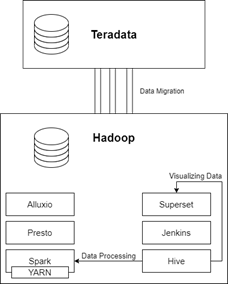
Additionally, because the migration source and destination were very different, to avoid data and functionality issues, Beyondsoft needed to redefine the data architecture. By redesigning the architecture to accommodate the destination format, Beyondsoft achieved performance improvements and complied with end-user requirements.
Furthermore, to avoid disrupting any services that were dependent upon the data, Beyondsoft worked with the customer to create a prioritization plan for the migration, starting with the most frequently used data first and ending with infrequently used data. Throughout the project, Beyondsoft ensured that more than 100 user entities who required data did not see any downtime, even when occasional issues were encountered.
The redesigned Hadoop architecture
The results
The data migration was a resounding success, delivering the following benefits to our customer:
- Migration from Teradata to Hadoop with no downtime.
- On-time project completion.
- Reduced data costs by 80%.
- Achieved a 30% performance improvement.
Technologies used
Beyondsoft used the following technologies:
- Presto as a query engine
- Alluxio for data orchestration
- Apache Hive for managing tasks and collaboration
- Yarn as a package manager
- Jenkins as an automation server
- Apache Superset for data exploration and data visualization
- Apache Spark for data processing